

6 Best Crypto Coins to Stake in October 2026
We believe in full transparency with our readers. Some of our content includes affiliate links, and we may earn a commission through these partnerships. However, this potential compensation never influences our analysis, opinions, or reviews. Our editorial content is created independently of our marketing partnerships, and our ratings are based solely on our established evaluation criteria. Read More





The best crypto to stake in 2026 splits cleanly into two camps, and picking the wrong one for your risk tolerance is the mistake worth avoiding. Blue-chip proof-of-stake coins such as ETH, SOL and ADA pay single-digit yields backed by deep liquidity and multi-year track records. Presale tokens advertise triple-digit APYs funded by token issuance rather than network fees.
Both are on this list, compared on the same terms, so you can see what you are trading away in each direction.
Two things changed the maths this year. US regulation settled: after the SEC reversed course in May 2025 and ruled that protocol staking is not a securities transaction, Kraken relaunched staking for US users, and Coinbase and Crypto.com expanded their staking-as-a-service products. At the same time, yields on established networks fell because rising participation dilutes a
fixed reward pool across more stakers. One rule applies to every coin below: US stakers owe ordinary income tax on rewards the day they are received, whether or not they sell, so compare net yields rather than headline APYs.
- In This Article
- In This Article
- Show Full Guide
Key Takeaways
- The highest APY cryptocurrency you can stake right now is Maxi Doge (MAXI); it’s currently offering 67% in yearly rewards.
- The best staking coins for beginners are Ethereum (ETH) and Solana (SOL): ETH has no minimum via Lido (stake as little as 0.01 ETH), and SOL can be staked directly from Phantom wallet in under 2 minutes with no lock-up period for native delegation.
- On a per-exchange basis, Cardano (ADA) is the best crypto to stake on Binance, SOL is the top option for Coinbase, and ETH for Kraken.
Staking is worth it if you:
- You want passive income
- You prefer long-term investing
- You avoid active trading
- You plan to hold crypto
- You seek steady rewards
Staking is not worth it if you:
- You need immediate liquidity
- You are uncomfortable with lock-up periods
- You trade frequently
- You avoid crypto risk
Best Crypto Coins to Stake Compared
Our selection of the best cryptos to stake includes a mix of high-yield presale staking options on presale tokens such as HYPER, MAXI, and SUBBD, as these offer the highest yields in the industry, and established large-cap staking coins such as ADA, ETH, and SOL, which offer lower staking rewards, but are safer plays, to balance upside potential with track record and liquidity.
The comparison table below shows staking APY, lock-up period, and current price so you can quickly compare potential returns, how long funds may be inaccessible, and entry cost, which are three of the biggest factors that affect real-world staking outcomes.
| Coin | Staking APY | Lock-Up Period | Current Price |
|---|---|---|---|
 HYPER +19.02% |
37% | Until TGE | $0.01368760 |
 MAXI +13.82% |
67% | Until TGE | $0.00028455 |
 SUBBD +4.92% |
20% | Until TGE | $0.05770750 |
 ADA 3.86% |
Binance with 3–5% (native delegation); up to 60.86% via Binance Locked Savings (promotional, short-term) | 0–60 days | $0.20 |
 ETH 1.21% |
1.13%–2.95% on Kraken | 0–14 days | $2,367.85 |
 SOL 2.19% |
4.1%–4.3% on Coinbase | 2–5 days | $101.87 |
Nominal APY vs Real Reward Rate: What You’re Actually Earning
Every staking page shows an APY. Most show the nominal rate, the raw tokens you receive before accounting for token inflation. The real reward rate is what matters: it’s the nominal APY minus the annual inflation rate of the token.
| Coin | Nominal APY (Approx) | Token Inflation | Real Reward Rate |
|---|---|---|---|
| ETH |
~3.5% |
~0.3% (post-Merge deflationary periods) |
~2.63% |
| SOL |
~6.5% |
~5–6% |
~0.5–1.5% |
| ADA |
~3.0% |
~0.9% |
~2.1% |
| BNB |
~8% |
~0% (burn model) |
~7–8% |
All Staking Reward Rates Updated as per October 2026
Why it matters: A project advertising 500% APY is almost certainly running high inflation to fund those rewards. The tokens you receive are worth less individually, which can cancel out, or invert, your stated return. Always check the token’s inflation schedule alongside its advertised APY.
Analyzing the Top Cryptos for Staking
1. Bitcoin Hyper (HYPER) – Overall Best Crypto to Stake for Passive Income
The top staking cryptocurrency to watch out for is Bitcoin Hyper. This project is the first-ever Layer 2 ecosystem for Bitcoin, delivering hyper-fast transaction speeds on the world’s largest blockchain network. It’s currently in its presale stage, where investors can stake the HYPER native token and earn 37% APY staking rewards.

Key to the Bitcoin Hyper Layer 2 network is its Solana Virtual Machine (SVM) smart contracts. The protocol unleashes Bitcoin’s Web3 potential, allowing users to deposit native BTC on Bitcoin Hyper and receive digital asset equivalents. Afterward, they can use the wrapped Bitcoin for staking, lending, and other DeFi activities. So far, nearly 80 million HYPER tokens have been staked on the platform.
Users should be aware of the decreasing staking rewards rate and understand the speculative nature of the project. Learn more about this upcoming L2 by reviewing the Bitcoin Hyper whitepaper. Follow the project’s X account and subscribe to the HYPER Telegram community for the latest updates.
| Chain | Ethereum and Solana |
| Staking APY | 37% |
| Lock-Up Period | Until TGE |
How Bitcoin Hyper Scored in Our Staking Methodology:
- APY & Reward Structure (25%): High. Offers the highest nominal yield in our lineup via presale staking incentives, though dynamic decay rates mean early yields will dilute as the staking pool expands.
- Security & Network Stability (25%): Speculative. While integrating SVM architecture is technically ambitious, the Layer 2 framework and canonical bridge remain unproven in live mainnet production.
- Lock-Up & Liquidity (20%): Low. Capital is illiquid—staked tokens remain locked until the Token Generation Event (TGE), meaning zero exit liquidity if market conditions shift.
- Utility & Ecosystem Demand (20%): Moderate. Staking utility is established on paper for future L2 gas and DeFi collateral, but actual demand depends entirely on post-launch developer adoption.
- Reputation & Dev Activity (10%): Developing. The team is executing against its published whitepaper milestones, but lacks the transparent track record of established PoS foundations.
Bitcoin Hyper Launches November 26, 2026. Last Chance to Buy!
Visit Bitcoin Hyper2. Maxi Doge (MAXI) – Highest APY Staking Crypto
With respect to Dogecoin, every dog has its day, and now it is the turn of Maxi Doge. Pushing the dog meme coin narrative forward, Maxi Doge brings max gym energy to the room with its branding. Maxi Doge is a meme coin play that brings a humorous slant to people’s obsession with wealth, power, and muscles. The presale has raised $4,883,644.56 so far.
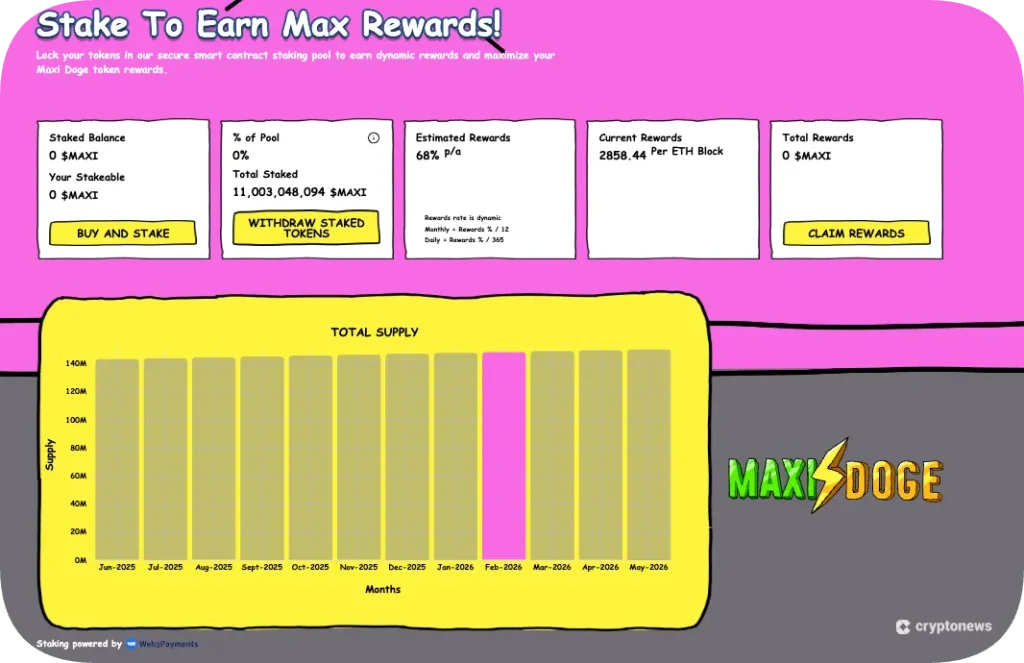
This is a project for the stakers, currently offering a 67% APY. Once MAXI completes its presale, it is expected to list on major exchanges, giving more people access to the token.
But right now, only those who head to the presale page or Best Wallet’s in-app “Upcoming Tokens” tab are able to buy MAXI and start staking. 25% of the supply is also reserved for competitions and bonuses.
| Chain | Ethereum |
| Staking APY | 67% |
| Lock-Up Period | Until TGE |
How Maxi Doge Scored in Our Staking Methodology:
- APY and Reward Structure (25%): High. Offers extreme headline APY during the presale phase to attract early capital, but the yield is heavily dilutive and will taper off sharply as more tokens enter the staking contract.
- Blockchain Security and Network Stability (25%): Moderate. Deployed as a standard ERC-20 token, benefiting directly from Ethereum’s robust base-layer consensus and security, though the custom staking smart contract carries standard unvetted contract execution risks.
- Lock-Up Periods and Liquidity (20%): Low. Staked assets remain completely illiquid until the official Token Generation Event (TGE) and subsequent DEX or CEX listings, exposing stakers to prolonged market risk with zero ability to exit early.
- Token Utility and Long-Term Demand (20%): Speculative. Primarily driven by meme appeal, marketing momentum, and community competitions rather than fundamental protocol utility, fee generation, or decentralized finance integration.
- Protocol Reputation and Development Activity (10%): Early-Stage. The project relies on community engagement and roadmap promises without a verifiable on-chain developer history or established foundation track record.
3. SUBBD (SUBBD) – Top Staking Token in the AI Sector
SUBBD offers a 20% APY for staking its SUBBD token. Stakers gain access to token-gated premium content and governance voting while supporting a platform bridging crypto with creator monetization. Integrated AI tools, like voice cloning and livestream automation, improve engagement for both creators and fans.
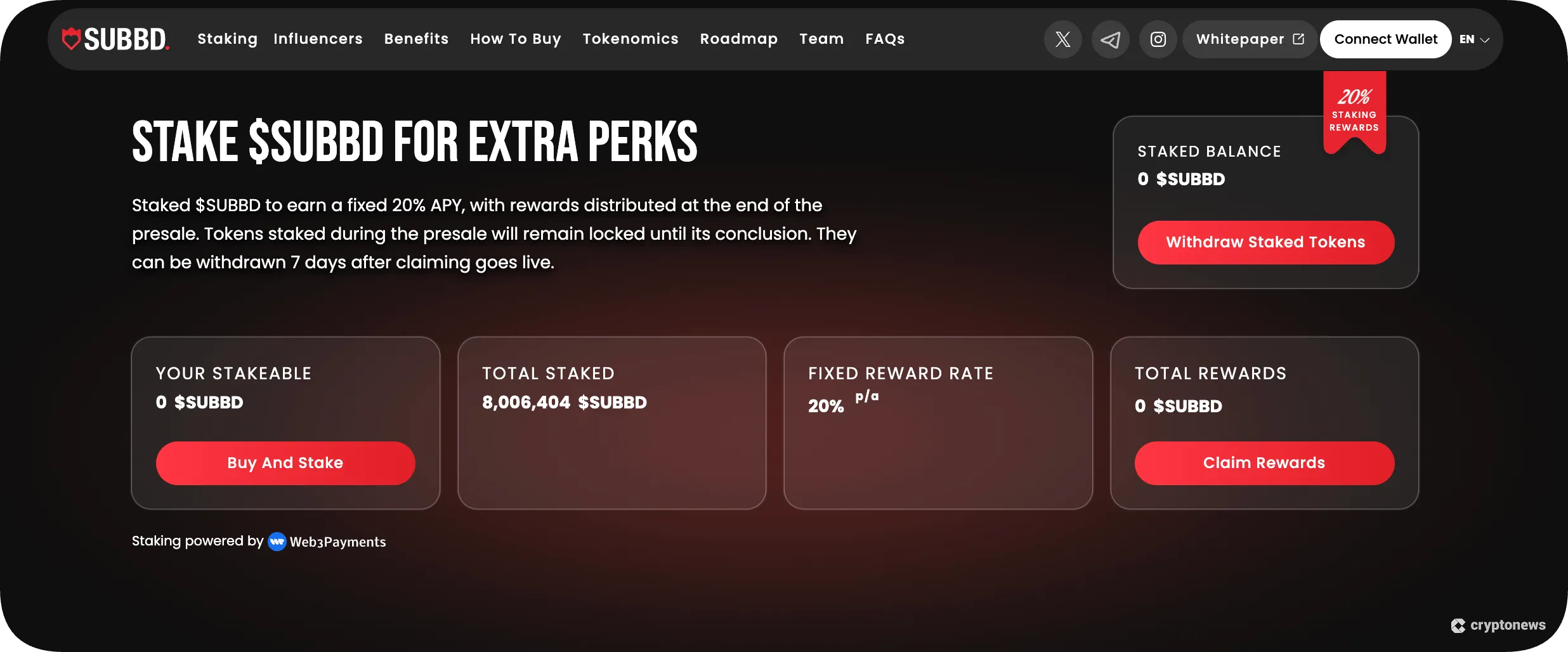
The project’s roadmap includes a Token Generation Event (TGE), DEX/CEX listings, and a global creator network. With 50 million tokens allocated for staking rewards, SUBBD prioritizes long-term holders. However, its success hinges on post-launch creator adoption and execution of its ambitious AI integrations.
Follow SUBBD on X or join the SUBBD community on Telegram to stay up to date on presale updates and platform developments.
| Chain | Ethereum |
| Staking APY | 20% |
| Lock-Up Period | Until TGE |
How SUBBD Scored in Our Staking Methodology:
- APY and Reward Structure (25%): Moderate to High. Presale staking provides an aggressive headline APY powered by a fixed 50 million token reward pool, but long-term yield viability is tied directly to platform revenue rather than protocol-level gas issuance.
- Blockchain Security and Network Stability (25%): Moderate. Built as an Ethereum ERC-20 token, benefiting from Ethereum’s base-layer consensus and finality, though the platform’s proprietary staking and creator payment contracts carry pre-audit, early-stage operational risks.
- Lock-Up Periods and Liquidity (20%): Low. Staked assets are completely illiquid through the presale phase and locked until the Token Generation Event (TGE), meaning holders cannot react or exit if timelines slip or market dynamics deteriorate.
- Token Utility and Long-Term Demand (20%): Promising. Unlike pure meme coins, SUBBD integrates tangible platform utilities including token-gated content access, subscription fee discounts, AI tooling tiers, and creator tip mechanics, though sustained demand requires actual mainstream creator onboarding.
- Protocol Reputation and Development Activity (10%): Developing. The product roadmap targets an ambitious overlap of Web3 monetization and generative AI creator tools, but technical execution and sustained developer delivery remain unproven prior to a live mainnet rollout.
Safest Cryptocurrencies for Staking- Large Caps and Established Coins
1. Cardano (ADA) – Best Crypto to Stake on Binance
Created by one of the founders of Ethereum, Cardano is considered one of the best proof-of-stake blockchains in 2026 and has a market cap that frequently places Cardano as a top 10 crypto project. ADA 3.86%, the native cryptocurrency, can also be staked on the Cardano network. Staking ADA earns you yearly interest in return for validating blocks on the blockchain. Also, with an average of 257 transactions per second (TPS), the Hydra scaling upgrade seeks to push the TPS to 1 million, which will mark Cardano as one of the fastest blockchain networks.
On Cardano, new blocks are verified through node selections. When an individual joins a node, ADA is locked away in that node. After blocks are produced, the nodes earn rewards distributed among the individuals. They’re often referred to as pool contributors. Investors can also choose to stake their assets in stake pool operators. These are individuals who have the specialized knowledge to perform the necessary tasks of maintaining the network.
The main options for staking one of the best proof-of-stake coins, Cardano, are centralized exchanges like Binance, Kraken, Crypto.com, and KuCoin, which offer varying APRs and flexible staking terms, and wallets such as Daedalus, Yoroi, and Ledger, which provide direct control over staking choices and enhanced security. Standard ADA delegation through wallets like Daedalus or Yoroi earns approximately 3–5% APY with no lock-up and no minimum. Rewards are distributed automatically every 5-day epoch. The 60.86% figure quoted on Binance reflects a short-term locked savings promotion, not the standard delegation yield.
| Chain | Cardano |
| Staking APY | Binance with 3–5% (native delegation); up to 60.86% via Binance Locked Savings (promotional, short-term) |
| Lock-Up Period | 0–60 days |
How Cardano Scored in Our Staking Methodology:
- APY and Reward Structure (25%): Moderate. Native delegation offers a sustainable, non-custodial 3–5% APY without slashing risks, backed by a fixed max supply (45 billion ADA) and reserve allocations, though real net yields remain modest after accounting for annual reserve dilution.
- Blockchain Security and Network Stability (25%): High. Cardano’s peer-reviewed Ouroboros consensus mechanism has operated without major chain halts, supported by a heavily decentralized validator distribution of over 3,000 independent stake pools.
- Lock-Up Periods and Liquidity (20%): High. Native on-chain staking features zero lock-up periods or unbonding delays, allowing full liquidity and instant spending directly from non-custodial wallets, while exchange-based locked products offer flexible terms up to 60 days.
- Token Utility and Long-Term Demand (20%): Moderate. ADA serves as the primary currency for network transaction fees, decentralized governance voting (Voltaire era), and native DeFi collateral, though ecosystem transaction throughput still lags leading EVM and SVM competitors.
- Protocol Reputation and Development Activity (10%): High. Maintained by IOG and the Cardano Foundation, the project consistently ranks near the top of public GitHub development commits, backed by formal academic verification and transparent, milestone-driven roadmap delivery.
2. Ethereum (ETH) – Best Staking Crypto for Beginners
Ethereum is one of the largest and most popular crypto tokens. It also has the potential to become one of the best cryptocurrencies for staking in 2026. Earning a yield on holding ETH 1.21% is very much possible.
Ethereum’s move to Proof-of-Stake in September 2022 made ETH the world’s most widely staked asset by total value. Native validator staking requires 32 ETH (~$83,500 at current prices) and earns around 3–4% APY from issuance plus priority fees. For most retail investors, liquid staking is the practical route: Lido Finance (stETH) and Rocket Pool (rETH) let you stake any amount, keep your assets liquid, and earn the same protocol-level yield minus a small commission (typically 10%).
On centralized exchanges, Kraken pays 1.13%–2.95% APY for ETH staking with a 0–14 day unstaking window. Coinbase offers around 2.9% through its cbETH liquid staking token. These rates are lower than native staking but come with simpler UX and no technical overhead.
Staking tax note: ETH staking rewards are taxed as ordinary income at fair market value when received. This applies whether you stake natively or through Lido/Rocket Pool — each reward distribution is a taxable event.
| Chain | Ethereum |
| Staking APY | Average 2.63% |
| Lock-Up Period | 0–14 days |
How Ethereum Scored in Our Staking Methodology:
- APY and Reward Structure (25%): High. Offers a sustainable 3–4% gross protocol yield powered by consensus issuance and MEV/priority tips, amplified by EIP-1559 base fee burning that offsets inflation and enhances real net yields for holders.
- Blockchain Security and Network Stability (25%): Exceptional. Ranks as the industry benchmark for economic security, backed by over 30 million staked ETH, more than one million active validator keys, and an established history of continuous, uninterrupted network uptime.
- Lock-Up Periods and Liquidity (20%): High. While native solo validators face dynamic unbonding queues and entry/exit churn limits, liquid staking protocols like Lido and Rocket Pool eliminate capital friction, providing immediate secondary market liquidity across deep DeFi pools.
- Token Utility and Long-Term Demand (20%): Exceptional. ETH serves as the foundational settlement asset and mandatory gas currency across the largest decentralized finance and layer-2 ecosystem in Web3, driving sustained structural demand for staking collateral.
- Protocol Reputation and Development Activity (10%): Exceptional. Ethereum leads all blockchains in core developer activity, client diversity, and academic research rigor, demonstrated by successful major hard forks like the Merge and Dencun.
3. Solana (SOL) – Best Crypto to Stake on Coinbase
Solana is a decentralized blockchain designed to support scalable, user-friendly apps worldwide. The network also attracts various dApps and developers due to its high speed and low costs. Additionally, the Solana blockchain supports more than 100,000 TPS, with an average transaction cost under $0.01.
Solana’s staking ecosystem is one of the most active in crypto, with over 65% of all SOL currently staked according to stakingrewards.com. Native delegation to a validator through wallets like Phantom or Solflare earns approximately 6–7% nominal APY, but because Solana’s network inflation runs at roughly 5–6%, the real reward rate (nominal minus inflation) is closer to 1–2%. That said, SOL price appreciation can significantly increase total returns for long-term holders.
Liquid staking via Marinade Finance (mSOL) or Jito (jitoSOL) gives you staking yields while keeping assets tradeable; both are audited, non-custodial protocols. On Coinbase, SOL staking pays 4.1%–4.3% APY with a 2–5 day unstaking period.
SOL is best suited for investors who want PoS yield on a high-throughput network and are comfortable with its history of brief network outages, and be aware that Solana has experienced multiple validator-consensus outages since 2022 (each lasting several hours), though the network has not had a full outage since 2023 as reliability upgrades have rolled out
| Chain | Solana |
| Staking APY | 4.1%–4.3% on Coinbase |
| Lock-Up Period | 2–5 days |
How Solana Scored in Our Staking Methodology:
- APY and Reward Structure (25%): Moderate. Delivers a competitive 6–7% nominal yield via native delegation, but network inflation (dilution) compresses the real net return down to roughly 1–2% unless supplemented by MEV tips from liquid staking protocols like Jito.
- Blockchain Security and Network Stability (25%): Moderate. Secured by over 65% of circulating supply and a high Nakamoto coefficient among its active validator set, though historical chain halts and client concentration deductions keep it below the top tier of resilience.
- Lock-Up Periods and Liquidity (20%): High. Native delegation features a predictable warmup/cooldown cycle of approximately 2–3 days (tied to Solana’s epoch timing), while deep liquid staking tokens like jitoSOL and mSOL provide near-instant exit liquidity across high-volume decentralized exchanges.
- Token Utility and Long-Term Demand (20%): Exceptional. SOL is the mandatory gas currency for one of the most heavily utilized Layer-1 ecosystems, driving structural buy pressure through high-frequency retail transactions, decentralized exchange volume, and liquid staking collateral.
- Protocol Reputation and Development Activity (10%): High. Supported by strong developer adoption, continuous core engine optimizations like the Firedancer validator client, and backing from major institutional liquidity venues, proving sustained long-term technical execution.
Other Proof-of-Stake Coins Worth Watching
| Coin | Nominal APY (approx) | Note |
|---|---|---|
| Avalanche (AVAX) | 6.5–11.6% | Fee-burn mechanism can make net AVAX supply deflationary when network usage is high |
| Polkadot (DOT) | 7–12% | 2026 reform cut unbonding from 28 days to 24–48 hours and capped total supply |
| Cosmos Hub (ATOM) | 14–19% headline | 21-day unbonding, the longest on this list; real yield is materially lower once inflation is netted out |
| BNB | ~8% | Staked via Binance’s BNB Vault; near-zero token inflation due to its burn model |
| Tezos (XTZ) | 2.8%-3.5% | Self-amending PoS chain with baking rewards built into every wallet; no third-party staking provider required |
| Algorand (ALGO) | 4.5%-6% | Pure PoS with no lock-up or minimum; rewards distributed via governance participation rather than traditional delegation |
| Polygon (POL) | 2.3%-4% | Staking secures Polygon’s PoS checkpointing layer; delegate via Polygon’s own staking dashboard or major exchanges |
New in 2026: Native Bitcoin Staking
Bitcoin isn’t Proof-of-Stake, so BTC couldn’t traditionally be “staked” until the Babylon protocol went live, letting holders stake BTC natively without bridging it to another chain or handing custody to a wrapper. Kraken now offers this directly: users lock BTC through Babylon’s timelock mechanism and earn rewards in BABY (Babylon’s native token) while keeping self-custody assurances closer to native Bitcoin than a wrapped-BTC DeFi product.
This is a different risk profile than staking ETH or SOL: you’re not earning network-issuance yield, you’re earning a separate token’s rewards for participating in a still-young protocol. Treat it as a speculative add-on to a staking portfolio, not a BTC-native yield replacement.
How Does Staking Crypto Work?
As mentioned, crypto staking involves locking your tokens in a blockchain network to support its operations. Here’s an overview of how it works:
- Choose a staking platform: You’ll select a wallet or exchange that supports staking for your chosen coin.
- Lock your tokens: Next, you’ll make a deposit and lock a certain number of tokens into the staking pool.
- Validate transactions: Your staked tokens are selected by the network to confirm and validate transactions. This process helps to ensure that all transactions are accurate and secure.
- Maintain network security: By validating transactions, your tokens help prevent fraud and maintain the overall integrity of the blockchain.
- Earn rewards: In return, you receive staking rewards, typically in the form of additional tokens.
For example, staking 10 ETH at a current native rate of ~3.5% would earn approximately 0.35 ETH in a year, worth roughly $915 at a $2,600 ETH price. This is similar to a high-yield savings account but without FDIC protection and with exposure to ETH price fluctuations.
Staking helps secure the network, and in exchange, you earn passive income. Be aware, however, of lock-up periods and the risk of token value fluctuations.
How Much Can You Actually Earn Staking Crypto?
The honest answer depends on how much you stake and which coin you pick, so here is the arithmetic rather than a promise. These figures use nominal APY and assume the token price holds flat; a big assumption, and the reason staking returns and investment returns are not the same thing.
|
Staked amount |
ETH at ~3.5% |
SOL at ~6.5% |
ADA at ~3.0% |
BNB at ~8% |
|
$1,000 |
$35 |
$65 |
$30 |
$80 |
|
$5,000 |
$175 |
$325 |
$150 |
$400 |
|
$10,000 |
$350 |
$650 |
$300 |
$800 |
|
$50,000 |
$1,750 |
$3,250 |
$1,500 |
$4,000 |
Two adjustments turn those headline numbers into what you keep.
First, inflation. SOL’s ~6.5% nominal looks like double ETH’s, but Solana issues 5–6% new supply annually against Ethereum’s ~0.3%, so the real reward rate lands near 1–2% for SOL versus ~2.6% for ETH. On a real basis the ranking inverts.
Second, tax. US stakers owe ordinary income tax on rewards at the moment of receipt. At a 24% marginal rate, that $650 of SOL on $10,000 staked is closer to $494 after federal tax, before any state liability, and you owe it whether or not you sold.
So the realistic expectation for a $10,000 stake in a blue-chip proof-of-stake asset is a few hundred dollars a year after inflation and tax. Anyone promising that staking replaces an income is selling something. The case for staking is that it compounds a position you were going to hold anyway, not that it is a yield strategy on its own.
Is Staking Crypto Worth It in 2026?
You might be eager to begin investing in some of the assets from our staking coins list. However, it’s important for investors and traders to review the benefits of staking coins. The sections below discuss whether staking cryptocurrencies could be a worthwhile investment for you.
✅ Earn Staking Rewards Passively
Generating passive rewards is the biggest benefit of staking cryptocurrencies. It allows you to grow your investments without actively trading. Like a savings account, you generate a fixed income yearly from your holdings.
To take advantage of this opportunity, we urge you to choose reliable staking platforms and compare yield rates. The most well-known platforms include Binance, Coinbase, and dedicated wallets like Trust Wallet. You can also diversify your staked tokens to balance risk and maximize rewards. This strategy helps build wealth steadily while supporting the blockchain network.
✅ Contribute to Network Security
Staking contributes to network security by validating transactions and maintaining blockchain integrity. When you stake, your tokens help verify transactions, thus preventing fraud and making the network more reliable.
For example, Ethereum transitioned to a PoS consensus mechanism in 2022, relying on staking to secure its network. As more investors are staking crypto, there’s also higher security and stability, which can increase the cryptocurrency’s value.
If you choose a project you believe in, staking can be more rewarding. You’ll contribute to the overall vitality of a project that you support while also making a profit. In essence, by staking, you earn passive income and help secure the network, benefiting the entire ecosystem.
What Are the Risks of Staking Crypto?
|
Risk |
What actually happens |
Who it hits hardest |
|
Price volatility |
A 10% APY means nothing if the token drops 40%. Your rewards are paid in the same asset that is falling. |
Everyone; worst on small-caps and presales |
|
Lock-up / unbonding |
Funds are frozen while the market moves. Cosmos takes 21 days to unbond, Polkadot now 24–48 hours, Cardano native delegation none at all. |
Anyone who may need liquidity inside a month |
|
Slashing |
Validators that double-sign or go offline are penalised, and delegators lose a share of stake with them. Ethereum slashing is rare but real; Cardano has no slashing. |
Delegators who pick validators on APY alone |
|
Smart contract failure |
Liquid staking tokens (stETH, mSOL, jitoSOL) depend on contract code. An exploit can de-peg the receipt token even when the underlying stake is untouched. |
Liquid stakers and DeFi loopers |
The practical defence is boring: split stake across more than one validator, check the validator’s uptime and commission before delegating rather than after, and treat any advertised APY above roughly 20% as a question about token inflation rather than a return.
How to Pick the Best Staking Cryptocurrency
In this section, we provide tips on what to consider, including high APY, lock-up time, and platform security. These factors help you make informed decisions and optimize your staking rewards.
🚀 High APY
APY stands for Annual Percentage Yield, representing the yearly return on investment, including compound interest. Investors should choose the highest APY crypto staking options to maximize returns. For example, some established cryptos can yield an APY of 14% or more. This yield is high when compared to the average S&P 500 return of around 10% annually.
To find high APY cryptos, you’ll compare staking platforms and yield percentages. Binance, Coinbase, and Kraken provide information on staking yields. Be sure to consider the token’s stability and project credibility alongside high APY rates. This strategy helps maximize passive income from your crypto investments.
⏳ Lock-Up Time
Many cryptocurrencies offer flexible lock-up periods, allowing investors to stop staking their assets at any moment. Fixed lock-up periods are likely to attract a higher APY.
However, investors looking to stake for short intervals may benefit from choosing digital assets that offer flexible options. For example, Cardano allows investors to lock up their assets for a minimum of 30 days on Binance.
🛡️ Platform Security
Investors should choose secure platforms that protect them against hacks and theft. For example, Binance and Coinbase are known for their robust security measures. They offer two-factor authentication and insurance for stored assets.
To stake on secure platforms, you should research the platform’s security features, user reviews, and past incidents. The most reliable platforms have strong reputations and advanced security protocols. Ultimately, your job is to safeguard your investments and earn passive crypto income without unnecessary risks. Using a hardware wallet for staking is a smart step that crypto veterans use to earn a yield securely without giving up ownership of their assets.
Liquid Staking vs Traditional Staking
Traditional staking locks your tokens for a set period. Liquid staking protocols solve this by issuing you a receipt token (e.g., stETH for Ethereum, mSOL for Solana) that represents your staked position and can be used in DeFi, traded, lent, or used as collateral, while your underlying stake continues earning rewards.
| Protocol | Asset | Liquid Token | Annual Yield (approx) |
|---|---|---|---|
| Lido | ETH | stETH |
~3.2% |
| Rocket Pool | ETH | rETH |
~3.0% |
| Marinade Finance | SOL | mSOL |
~6% |
| Jito | SOL | jitoSOL |
~6.5% + MEV rewards |
Word of caution: Liquid staking introduces smart contract risk. If the protocol is exploited, your receipt tokens can lose value even if the underlying staked asset is unaffected. Stick to audited, battle-tested protocols.
Methodology: How We Ranked the Best Staking Cryptocurrency
By weighing the factors described below, our experts established a ranking system that highlights the most rewarding and secure staking cryptocurrencies while considering long-term sustainability. This methodology ensures that our recommendations are based on data-driven insights rather than just short-term yield potential.
APY and Reward Structure (25%)
Each currency offers its own staking reward system, so to compare them, we considered each one’s APY (annual percentage yield) and how sustainable the reward structure is over time. High APYs are usually attractive at first sight, but we also analyzed whether the rewards are inflationary or designed for long-term value retention.
Early-stage presale assets like Bitcoin Hyper score exceptionally high on raw promotional APY but lose points on yield durability, whereas mature networks like BNB or Ethereum score higher for net-yield sustainability despite lower nominal rates.
Blockchain Security and Network Stability (25%)
The staking protocol’s security is non-negotiable for users and validators. So we checked if each blockchain has an efficient consensus mechanism, is resistant to attacks, and has a stable history. Networks that prove they have strong security and decentralization also offer a safer staking environment.
Battle-tested L1s with distributed validator sets earned top marks here, while unaudited or pre-mainnet L2 architectures took sharp deductions for execution and bridge vulnerability risks.
Lock-Up Periods and Liquidity (20%)
Lock-up periods are required for staking. However, some cryptocurrencies have more flexible options, while others require funds to be locked for longer periods. Liquidity is also considered, guaranteeing that stakeholders have good access to their funds if they choose to move them.
Protocols offering liquid staking or flexible unstaking windows scored highest, whereas tokens locked until an unconfirmed Token Generation Event (TGE) took heavy liquidity penalties.
Token Utility and Long-Term Demand (20%)
Usually, a staking cryptocurrency’s success in the long run depends on its utility within its ecosystem. We checked if the token can be used for a practical purpose beyond staking, such as governance, payments, or DeFi applications.
Tokens deeply embedded in gas execution and active DeFi collateral scored best; purely speculative reward tokens without realized transaction demand scored near the bottom.
Protocol Reputation and Development Activity (10%)
To be credible, a staking protocol must have an active development team and a well-maintained ecosystem. We analyzed the cryptocurrency roadmaps, recent updates, and developer engagement to see if the network is compromised by ongoing innovation and security improvements.
Established developer mindshare on GitHub drove high scores for primary ecosystems, while early roadmaps and unproven teams received minimal baseline weighting.
Conclusion: What Is the Best Crypto to Stake in 2026?
Staking crypto can be a great way to earn passive income, and some of the best options include Bitcoin Hyper (HYPER), Ethereum (ETH), Solana (SOL), and Cardano (ADA), all known for strong ecosystems and reliable staking rewards. These cryptocurrencies offer competitive yields, network security benefits, and long-term growth potential.
As with everything else in the crypto world, staking comes with risks. Token price volatility, lock-up periods that limit liquidity, and potential slashing penalties if validators fail to perform properly can all erode your investment to nothing. Additionally, choosing the wrong staking platform could expose you to security risks. Always do your own research to maximize your rewards while minimizing potential downsides.
Visit Bitcoin HyperFAQs
What coins have the highest staking rewards?
What is the best crypto to stake in 2026?
What is the safest crypto to stake?
Is crypto staking profitable?
Which crypto platform is best for staking?
What is the most profitable staking crypto?
Are crypto staking rewards taxed?
Is crypto staking legal in the US?
What is the best crypto to stake for the long term?
Does staking crypto actually make money?
Can you lose money staking crypto?
References
- Bitcoin Market Journal: Ethereum Staking Yields
- Statista: Biggest cryptocurrencies in the world based on total staked value
2M+
250+
8
70





 in numbers

About Cryptonews
Our goal is to offer a comprehensive and objective perspective on the cryptocurrency market, enabling our readers to make informed decisions in this ever-changing landscape.
Our editorial team of more than 70 crypto professionals works to maintain the highest standards of journalism and ethics. We follow strict editorial guidelines to ensure the integrity and credibility of our content.
Whether you’re looking for breaking news, expert opinions, or market insights, Cryptonews has been your go-to destination for everything cryptocurrency since 2017.
