


Europe's crypto exchange market entered a new phase on July 1, when the MiCA transitional period expired across the EU.
Under the framework, crypto-asset service providers that relied on transitional arrangements had to obtain MiCA authorisation or stop providing the relevant services.
ESMA has also warned unauthorised providers to wind down their EU operations and reminded users that MiCA protections do not apply to unauthorised CASPs.
The transition has reduced the number of platforms able to serve European clients under the new framework. According to the CASP Tracker data cited by Gate Europe, 84 of the world's 100 largest exchanges did not hold MiCA authorisation as of Sept. 28.
For exchanges that have secured authorisation, the regulatory hurdle is increasingly becoming only one part of the competition. Liquidity, trading costs, available assets and execution quality are emerging as additional factors for users comparing licensed venues.
Gate Europe is among the platforms that secured authorisation ahead of the deadline. Its European operations are conducted through Gate Technology Limited, which received MiCA authorisation from the Malta Financial Services Authority on Sept. 29, 2025, according to the company. The firm subsequently passported its services across the European Economic Area.
As the European arm of Gate, the global exchange founded in 2013, Gate Europe entered the post-transition period with an established MiCA authorisation rather than having to complete the process after the July deadline.
Gate Europe expands markets and liquidity
Gate Europe has expanded its asset coverage since the start of the transition's final phase. According to the company, it announced at least 68 new spot listings between June 16 and Sept. 22, bringing its platform to 382 trading pairs covering approximately 190 assets.
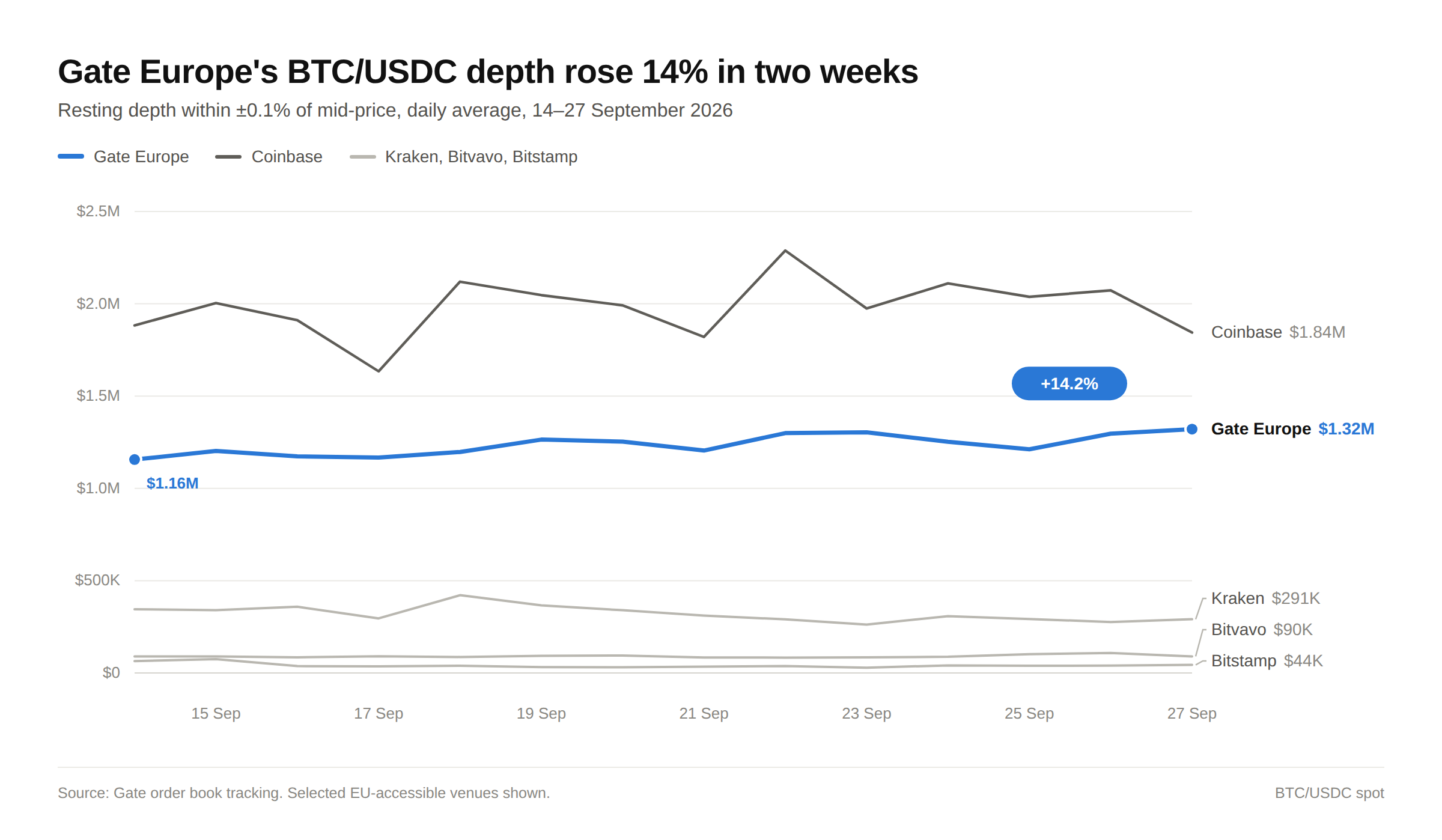
The exchange also reported deeper order books for its USDC markets. Between Sept. 14 and Sept. 27, BTC/USDC depth within 0.1% of the mid-price increased about 14% to $1.32 million, while ETH/USDC depth rose approximately 12% to $555,000, based on Gate's order-book tracking.
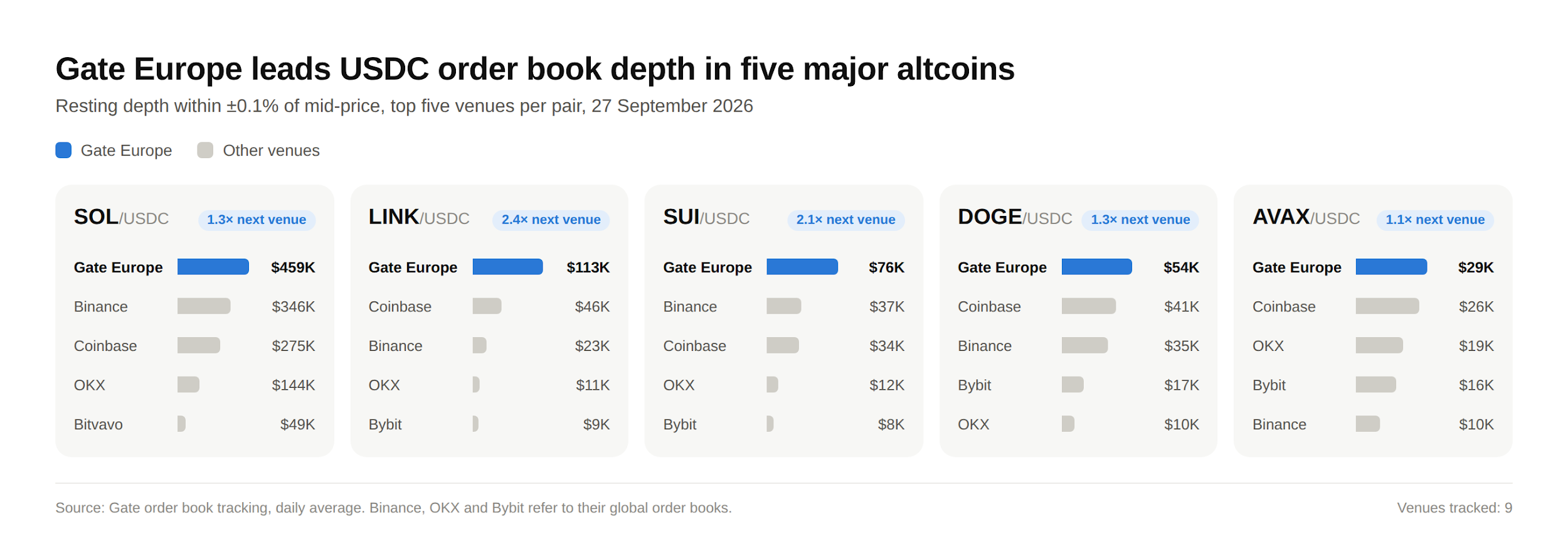
Independent market data cited by Gate also shows the platform among the larger MiCA-authorised venues by spot liquidity. On DefiLlama's MiCA exchange dashboard, Gate Europe's spot depth within 2% of the mid-price stood at $15.9 million, compared with $13.6 million for OKX EU at the cited measurement.

Gate Europe also completed a PCI DSS v4.0.1 Level 1 assessment on Sept. 15 covering its Gate Connect and Gate Card services. PCI DSS Level 1 is the highest assessment tier under the payment-card security standard.
"The deadline did not shrink the European market, it concentrated it," Gate Europe CEO Giovanni Cunti said. "Users can now compare licensed venues side by side on independent data, and the platforms that grow will be the ones that win on execution."
Cunti said liquidity, trading volume, market coverage and fees would be among the factors determining how exchanges compete in the post-MiCA environment.
The broader impact of the transition remains difficult to quantify so soon after the deadline. However, the regulatory shift has created a more defined group of authorised providers competing for European users, while independent market-data platforms offer increasingly direct comparisons of liquidity and trading conditions.
For exchanges that secured authorisation early, the next stage is therefore less about obtaining access to the European market and more about retaining and expanding their user base through trading conditions, asset coverage and infrastructure.
 Arman Shirinyan
 Dan Burgin