

Jonatan Randin, Senior Market Analyst at PrimeXBT.
Crypto traders may not usually pay much attention to tanker traffic in the Persian Gulf. But this year, disruptions in the Strait of Hormuz have become an important part of understanding Bitcoin's price movements, even on days when there is little crypto-specific news.
The connection is not as distant as it might seem. Rising oil prices feed into inflation, influence the Federal Reserve's interest rate decisions and ultimately affect the liquidity available to risk assets such as Bitcoin. Understanding this chain helps explain some of crypto's recent volatility and what could drive its next move.
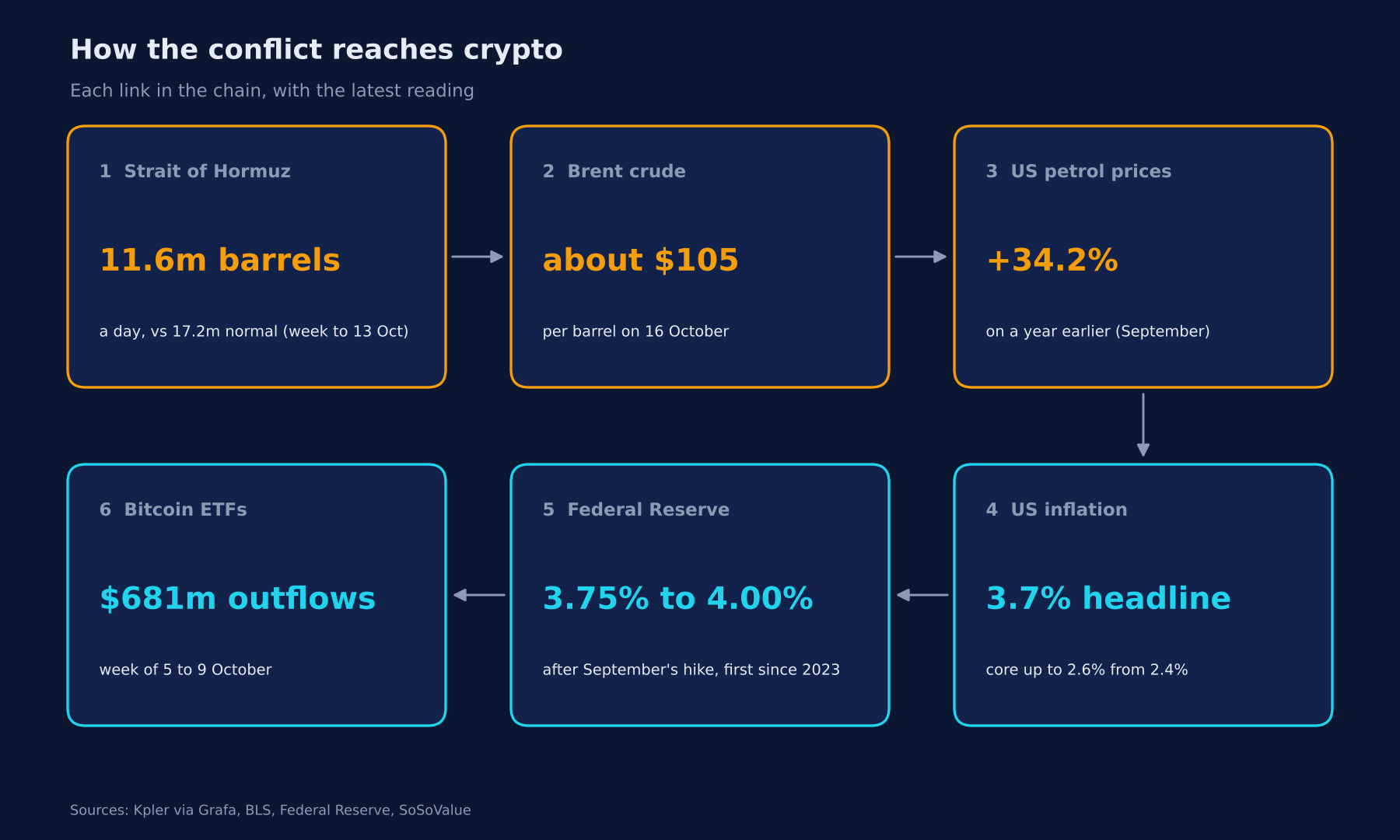
Each step from the Strait of Hormuz to Bitcoin fund flows, with the latest reading for each. Sources: Kpler via Grafa, BLS, Federal Reserve, SoSoValue.
Oil
The Strait of Hormuz normally carries around something close to a fifth of the world's oil, and since this conflict involving the U.S. and Iran started at the end of February, traffic, has been very limited. In the week to October 13, the oil flows were about 11.6 million barrels per day, compared to a normal level of around 17 million.
Brent crude, which is the global benchmark for oil, started this year around $61 and reached a high of around $118 at the end of March. It then retraced back to the lows of around $70 during the summer, when there was a ceasefire, and then it whipsawed back up again as attacks on tankers continued. On October 16, it was trading around $105.
Inflation
When the price of oil goes up dramatically like this, that tends to affect consumers quickly through the price of fuel. In January, U.S. fuel prices were 7.5% lower than a year earlier, and by May they were 40.5% higher. The headline inflation number hit 4.2%, and that's the highest since April of 2023.
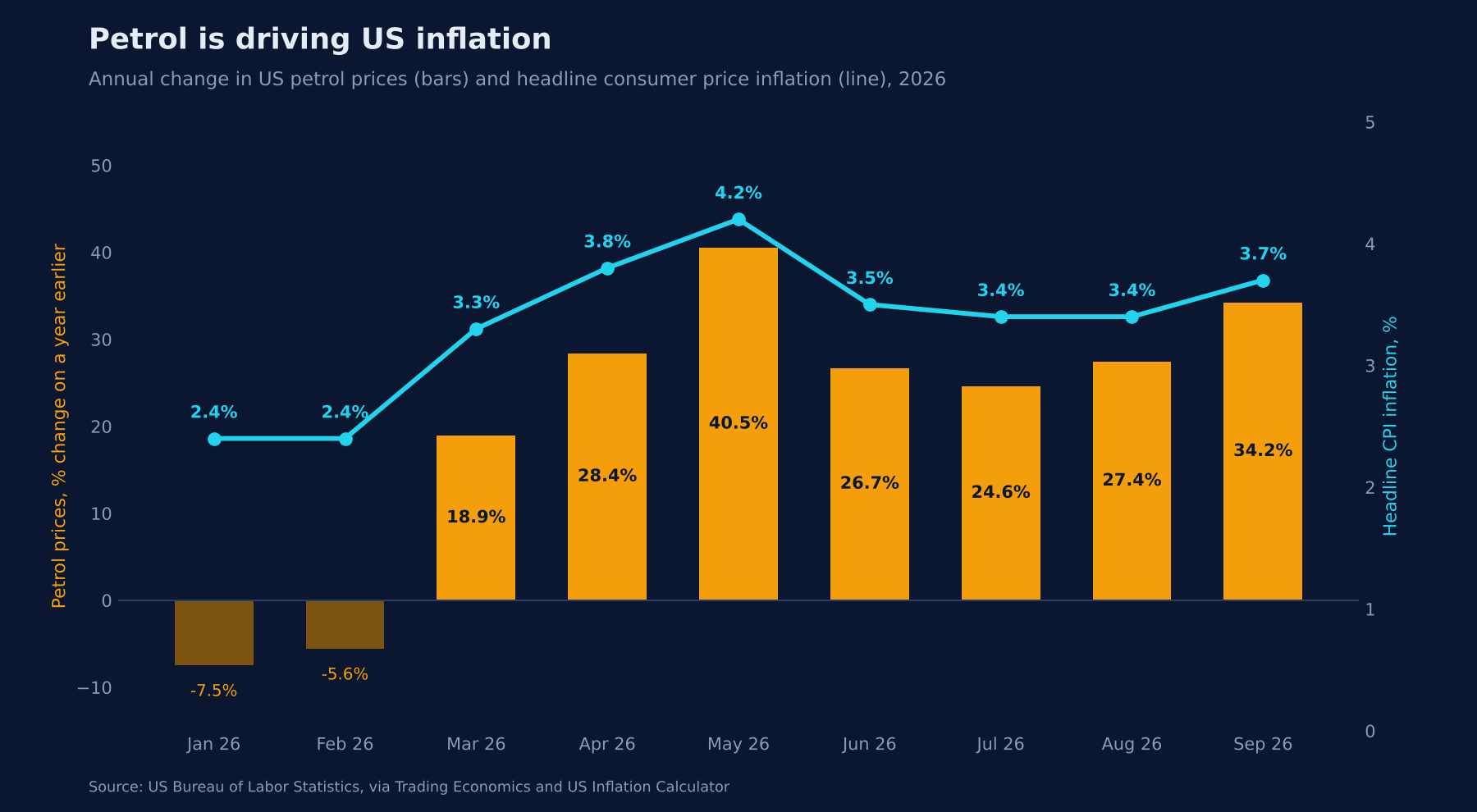
When petrol prices jumped, headline inflation followed within the same month. The June dip came during the ceasefire. Source: US Bureau of Labor Statistics.
We have the September figures that were released on the 14th of October. Here, we saw that inflation went back up to 3.7%, and fuel was up 34.2% that year and accounted for more than half of that monthly rise. If you look at core inflation, which excludes food and energy, it climbed higher to 2.6% from 2.4%.
That last number is important because it can potentially suggest that energy costs may be spreading into other prices within the economy.
The Fed
The U.S. central bank, the Fed, raised their rates to 3.75% to 4% in September. This is their first hike since 2023, and a lot of people expected another one before the end of the year. After the CPI report, the odds of an October hike increased from around 22% to closer to 50% in just one day, before relaxing once the new Fed chair, Kevin Warsh, said that he does not prejudge meetings.
Crypto
As you know, Bitcoin does not pay any interest. When rates rise, assets that do pay interest or yield, as it's also called, will look a bit more attractive. The U.S. dollar tends to become stronger in that scenario, which then drains liquidity from the riskier assets like Bitcoin.
In the week of 5 to 9 October, the U.S. spot ETFs saw an outflow of about 681 million, and that's a lot. That's the largest weekly withdrawal since June, and Bitcoin then dropped below 81,000 the morning after we got the CPI report.
It's not a straight line
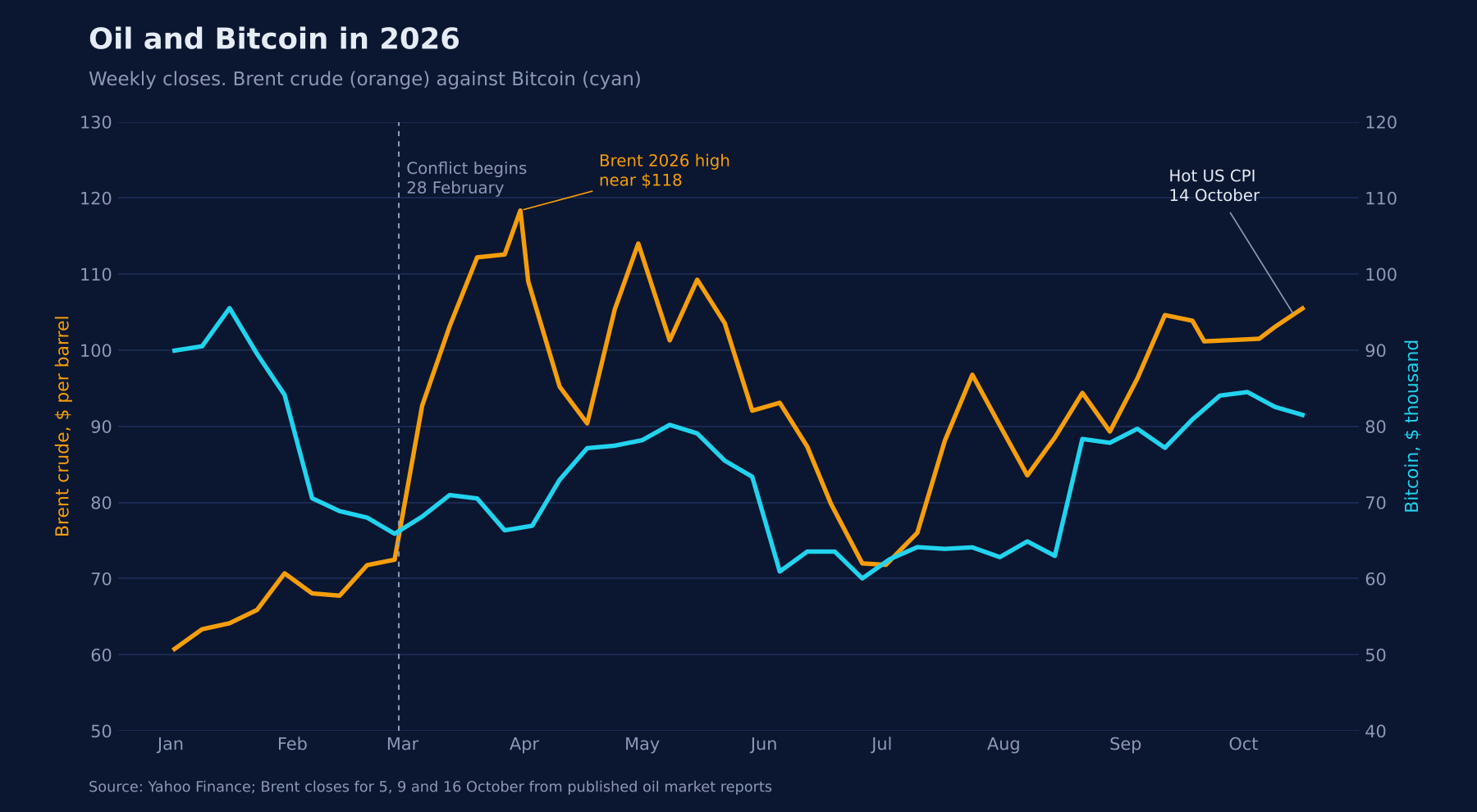
Oil and Bitcoin don't simply move in opposite directions. The link runs through inflation and the Fed. Source: Yahoo Finance, with October Brent closes from published oil market reports.
Now, if we put oil and Bitcoin on one chart together, it shows us something quite interesting and important. They will not move as mirror images, meaning they are not completely correlated. Obviously, when oil fell back to the low 70s in June, Bitcoin dropped below 60K because the Fed was holding their rates, and rate cuts were apparently no longer in focus.
Then, in late August and September, Bitcoin once again climbed, even as oil also climbed again and the Federal Reserve hiked. The reason for that is because the hike was expected.
Now, what moves Bitcoin is not the oil price itself. It has more to do with what oil does to inflation, and then what inflation does to the Fed. That's the chain we talked about. A deal that would potentially open the Strait of Hormuz again could ease that whole chain of events, and of course, further escalation would then tighten that chain of events.
Trading across markets with PrimeXBT
As geopolitical developments continue to influence inflation, interest rates and market sentiment, traders need the flexibility to respond to opportunities across different asset classes. PrimeXBT, a global multi-asset broker and crypto service provider, brings these markets together on its proprietary PXTrader 2.0 platform, where clients can trade Forex, Commodities, Indices, Shares, and Crypto CFDs alongside Crypto Futures from a single account.
Traders can fund their accounts in USD, USDT, USDC, BTC or ETH and access traditional financial markets without first converting their holdings into fiat. The platform also offers advanced TradingView charting, Stop Loss and Take Profit orders, adjustable leverage and other risk management tools to help traders navigate volatile conditions.
New clients can also benefit from PrimeXBT's VIP Welcome offer, which automatically grants VIP 4 status for their first 14 days, with no usual trading volume requirements. This includes 15% off Forex and CFD spreads, up to 50% off Gold and Bitcoin CFD spreads, 33% lower Crypto Futures taker fees and access to 10% cashback on eligible trading costs through the broker's Rewards Center.
With access to both traditional and crypto markets, flexible funding options and competitive trading conditions, PrimeXBT gives traders the flexibility to explore opportunities across asset classes as global market conditions evolve.
Start trading with PrimeXBT.
About PrimeXBT
PrimeXBT is a global multi-asset broker and crypto asset service provider trusted by traders in more than 150 countries. The platform bridges traditional and digital markets within one integrated environment, redefining versatility and innovation in online trading. Clients can access Forex, CFDs on indices, commodities, shares, crypto, and Crypto Futures, as well as buy, store and exchange cryptocurrencies. This unified experience extends across both the native PXTrader 2.0 platform and MetaTrader 5, supported by advanced risk-management tools and a wide range of funding options in crypto, fiat and local payment methods. Since 2018, PrimeXBT has focused on empowering traders through broad multi-asset access, fair and transparent conditions, professional-grade technology and dedicated human support. By combining expertise, trust and a client-first approach, PrimeXBT sets a benchmark of excellence in the financial industry and provides traders with the tools they need to trade, grow and succeed with confidence.
Disclaimer: The content provided here is for informational purposes only and is not intended as personal investment advice and does not constitute a solicitation or invitation to engage in any financial transactions, investments, or related activities. Past performance is not a reliable indicator of future results. The financial products offered by the Company are complex and come with a high risk of losing money rapidly due to leverage. These products may not be suitable for all investors. Before engaging, you should consider whether you understand how these leveraged products work and whether you can afford the high risk of losing your money. The Company does not accept clients from the Restricted Jurisdictions as indicated on its website / T&Cs. Some products and services, including MT5, may not be available in your jurisdiction. The applicable legal entity and its respective products and services depend on the client's country of residence and the entity with which the client has established a contractual relationship during registration.
 Arman Shirinyan
 Dan Burgin