

Disclaimer: The opinions expressed by our writers are their own and do not represent the views of U.Today. The financial and market information provided on U.Today is intended for informational purposes only. U.Today is not liable for any financial losses incurred while trading cryptocurrencies. Conduct your own research by contacting financial experts before making any investment decisions. We believe that all content is accurate as of the date of publication, but certain offers mentioned may no longer be available.

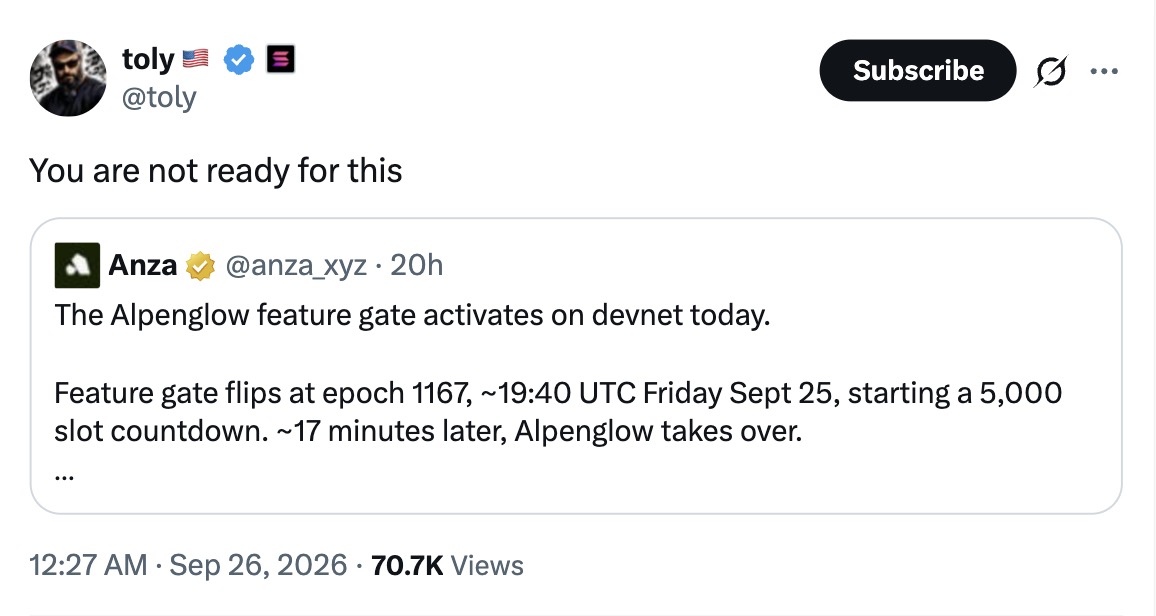
Solana co-founder Anatoly Yakovenko drew the industry's attention to the next major step in blockchain evolution with a brief comment on the latest release: "You're not ready for this."
The comment followed the successful migration of Solana's developer network (devnet) to the new Alpenglow consensus protocol by Anza engineers. The upgrade, which radically changes how blocks are processed, is designed to reduce transaction finality time from ~12.8 seconds to 100–150 milliseconds.

The update replaces the longstanding TowerBFT algorithm with Votor, a voting system developed with researchers from ETH Zurich and approved by validators under SIMD-0326. Its main innovation is moving validator coordination off-chain.
Solana is being reworked under the hood: Why it's needed and how it will affect the speed of everyday transfers
Until now, technical vote transactions have taken up as much as 75% of Solana's block capacity. They are now aggregated into compact cryptographic BLS certificates. This frees up that hidden network capacity for user transactions and lowers costs for node operators. The virtual machine (SVM) and smart contract structure remain unchanged.
According to Anza, the protocol activation (Alpenswitch) on devnet took place at epoch 1167 after a 17-minute countdown; the system had been deployed on testnet the day before. The new consensus uses a "20+20" fault-tolerance model, remaining stable even if one-fifth of validators go offline while another 20% of nodes are under attack.
When validators representing at least 80% of the stake respond, finality takes ~100 ms; in fallback mode, it takes ~150 ms.

The September release of Alpenglow on public clusters opens a testing phase for dApps where response speed is critical, including payment systems and Web3 games.
The timeline for integration into mainnet-beta has not been disclosed while stability monitoring is underway. However, the technological foundation for Solana's transition to sub-second finality is now in place.
 Arman Shirinyan
 Dan Burgin