

Disclaimer: The opinions expressed by our writers are their own and do not represent the views of U.Today. The financial and market information provided on U.Today is intended for informational purposes only. U.Today is not liable for any financial losses incurred while trading cryptocurrencies. Conduct your own research by contacting financial experts before making any investment decisions. We believe that all content is accurate as of the date of publication, but certain offers mentioned may no longer be available.

On October 1, 2026, cross-chain protocol NEAR Intents broke its silence and officially confirmed that its infrastructure had been hacked, costing the project $3.8 million.
The publication of the official report and acknowledgment of the vulnerability hit the market immediately: the native NEAR token plunged 7.5% within minutes, hitting a local low of $4.76, before partially rebounding to $4.84.
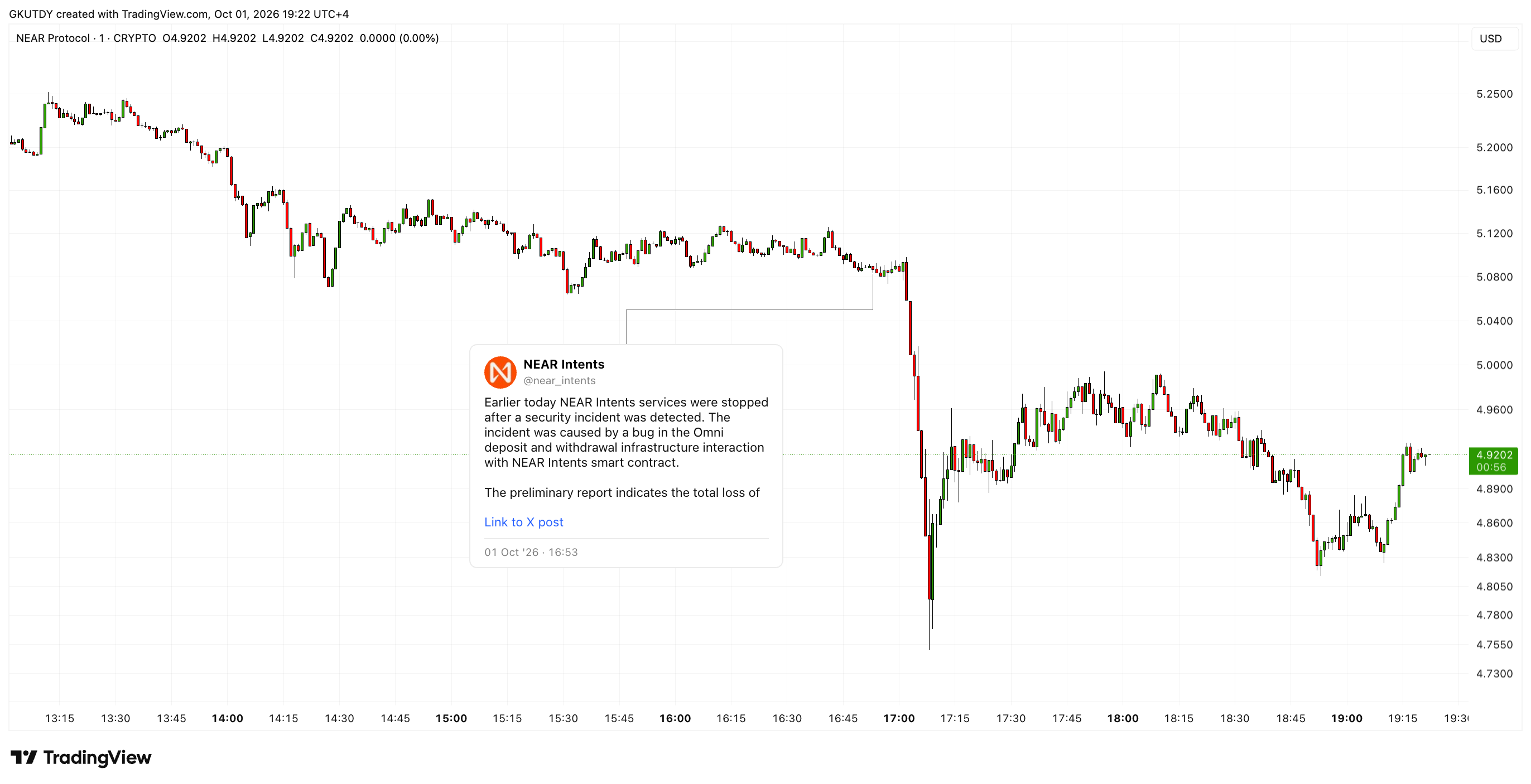
The situation looks paradoxical. Just a couple of days earlier, the same protocol was celebrating a major success: its SHIELD security system had successfully blocked $50 million in transactions, foiling the hackers' attempt to launder funds after the high-profile Bitget exchange hack. But that external defense proved powerless against an internal integration error.
How a single integration bug nullified external defenses, costing $3.8 million
NEAR Intents is one of the year's leading technology trends, with more than $30 billion in trading volume. It implements the concept of Chain Abstraction. The idea is simple: instead of digging into the details of Web3, a user or AI agent simply states an intention — for example, "I want to swap Arbitrum USDT for native Bitcoin."
The underlying infrastructure handles all the routine work: finding bridges, calculating gas fees, and selecting networks.
That hidden complexity is exactly what let the project down. According to the team, the incident was caused by a bug in the interaction between the NEAR Intents smart contract and Omni's custody architecture.
The attackers exploited the vulnerability to make unauthorized withdrawals from the platform's hot wallet on BNB Chain (BSC). They quickly transferred the stolen assets to KuCoin, then converted them into Bitcoin through cross-chain bridges.

In response, the NEAR Intents team immediately rolled out a clear crisis plan:
- The vulnerability has been fixed: The smart-contract flaw has been patched. The main site, near(.)com, and basic services are expected to return within an hour.
- Bridges have been frozen: Deposits and withdrawals across 11 blockchains — including Polygon, TON, Optimism, Avalanche, and Scroll — will remain suspended for about 12 more hours, until Omni has completed its fixes.
- Financial guarantees: The project's treasury will fully compensate users for their losses. Assets held within the system, such as those in the hot wallet, can be safely converted as soon as service resumes.
The protocol has already brought law enforcement and blockchain analysts into the investigation to trace the movement of the stolen Bitcoin.

This case is a major precedent for the industry. NEAR Intents is positioned as a key financial layer for the AI agent economy, where agents need to interact with Web3 automatically, without manual transaction signing.
The hack showed that even when a project protects its external defenses effectively, an "intents" architecture remains vulnerable at integration points with conventional bridges.
The team's swift response and willingness to cover the losses from its own treasury helped the project avoid a reputational collapse. But security standards for cross-chain gateways will clearly have to be rewritten.
 Arman Shirinyan
 Dan Burgin