
MLB: 2026 AL MVP
Current Odds
15 more outcomes Listed by current odds, highest first
Odds Summary
Yordan Alvarez leads at 97.5% reported probability on Polymarket.
Polymarket · Last synced
Market Analysis
Alvarez’s 61% Lead Depends on Conviction the Ledger Barely Confirms
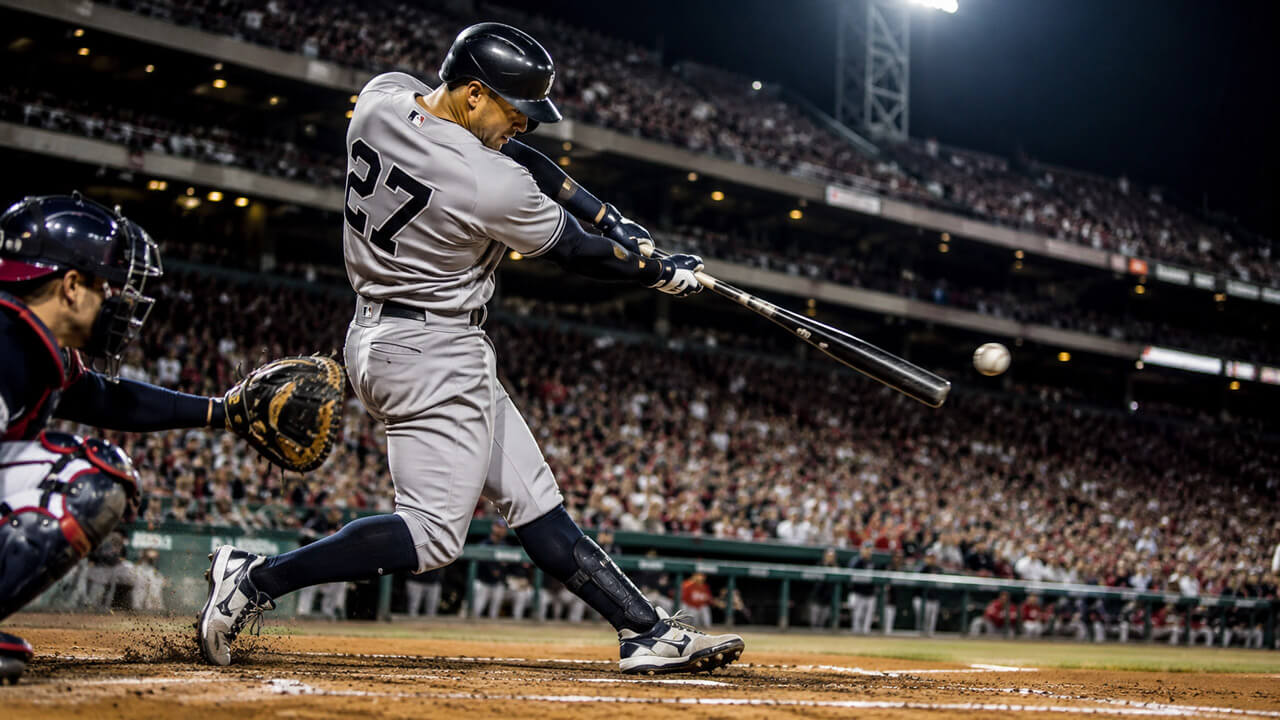
Yordan Alvarez’s dominance requires a sweeping baseball thesis, yet the supplied record contains no player-specific evidence supporting that separation. The gap between heavy turnover and limited open interest makes market structure a plausible competing explanation, with early-season availability and performance positioned to test both stories.

Yordan Alvarez’s 61% price looks less like an ordinary preseason preference than a concentrated claim that one player will control the 2026 American League MVP race. The non-obvious issue is evidentiary: the supplied record offers no injury, lineup, role, or recent-performance information explaining why Alvarez stands almost four times higher than Bobby Witt Jr. and vastly above every other named candidate. That leaves two plausible causal stories—strong conviction based on information outside the record, or a price shaped by concentrated activity and uneven positioning.
The leader quote carries a demanding baseball forecast
Alvarez at 61% and Witt at 15.5% account for more than three-quarters of the quoted probability among the supplied names. Aaron Judge sits at 1%, while José Ramírez is 1.6% and every other listed candidate remains below 4%. Market inference: the hierarchy assumes Alvarez has a substantially clearer path to season-long production and award support than established alternatives.
That separation requires several events to align. Alvarez would need enough playing time to build an MVP case, performance that remains distinctive across a full season, and insufficient competition from Witt, Judge, Ramírez, Gunnar Henderson and the wider field. Each condition is a hidden assumption because the factual record contains no supporting player news. The price therefore expresses a much stronger conclusion than the available baseball evidence can independently verify.
Heavy turnover supports two competing explanations
The market reports $981,150 in cumulative volume, $205,100 in liquidity and only $8,670 in open interest. Volume is roughly 113 times open interest. One interpretation is repeated acceptance of the Alvarez thesis over time. A competing inference is that much of the volume represents turnover, position recycling or activity that left relatively little outstanding exposure.
The $205,100 liquidity figure is the main reason to take the quote seriously: it indicates meaningful capital is available across the event. Its analytical limit is equally important. Aggregate liquidity reveals neither the depth available at Alvarez’s displayed price nor how many independent participants produced the hierarchy. No trader count is supplied. The record consequently cannot distinguish broad agreement from a smaller number of active accounts and liquidity providers.
Alvarez’s lead embeds fragile assumptions about the field
The 12 supplied outcomes sum to 89.6%. That means at least 10.4 percentage points sit outside these names, remain unrepresented in the supplied list, or arise from differences among the individual outcome markets. The apparent race is therefore wider than an Alvarez-versus-Witt framing suggests.
The low prices on Judge, Henderson, Corey Seager, Vladimir Guerrero Jr., Mike Trout, Julio Rodríguez and Cal Raleigh also imply that the market assigns each a narrow winning route. Yet the context provides no current health, roster, lineup or performance evidence explaining those discounts. A fast start by any one candidate would challenge two assumptions simultaneously: Alvarez’s expected separation and the market’s compressed treatment of the field.
Availability and early separation are the first decisive tests
Several concrete catalysts could force a different hierarchy. Official spring and Opening Day availability would test the playing-time assumptions embedded in every price. Confirmed absences, workload restrictions or lineup changes would weaken a candidate’s path; uninterrupted participation would remove one source of uncertainty.
April and May results would then test the performance premise. Alvarez combining regular availability with clearly superior production would support the current ordering. Comparable or stronger starts from Witt, Judge, Ramírez or an omitted candidate would weaken it, especially if Alvarez’s statistical advantage failed to emerge. By midseason, games played and relative production should carry more explanatory weight than preseason positioning.
A transaction that changed a candidate’s league eligibility would also matter under the stated resolution rule, which awards the contract to the 2026 AL MVP winner. This is a hypothetical catalyst rather than a current roster claim.
The strongest counter-signal is the market’s repeated persistence
The best argument against dismissing Alvarez’s lead as a structural artifact is the combination of nearly $1 million in volume and substantial reported liquidity. A price that survives repeated transactions can encode information absent from the supplied context. It may reflect external assessments of health, expected playing time or performance that this record does not document.
That counterargument gains force if Alvarez’s price remains near current levels after official availability reports and the first sustained stretch of regular-season data. It weakens if the hierarchy shifts sharply on routine news or modest early results. The 61% quote currently represents a powerful thesis with limited visible baseball evidence; the season’s first verified information will show whether that conviction has durable foundations.
Sources
What Could Move the Odds?
Market-Implied Thesis
At 96%, the market treats Yordan Alvarez as the overwhelmingly likely 2026 AL MVP, leaving little implied chance for the listed field.
The Yes price functions as an implied probability in this multi-outcome event, signaling a highly concentrated expectation rather than an official result.
What Could Reprice It
The eventual AL MVP winner decision or announcement is the key catalyst because it directly determines which single market outcome pays out.
Polymarket’s resolution rule ties settlement to the player who wins the 2026 American League Most Valuable Player Award; no announcement date is provided.
Where the Market May Be Weak
The 96% price may overstate consensus: accumulated trading volume does not establish executable depth, while present liquidity is much lower than turnover.
A multi-outcome market can show substantial historical activity yet remain vulnerable to repricing if available liquidity is limited when new award-relevant information emerges.
Counter-Signal
The thesis can fail because settlement selects one award winner, while Junior Caminero and Cam Schlittler still retain the largest residual chances.
Those alternatives show that the market has not fully eliminated another winner, although their prices alone do not provide independent evidence on voting or performance.
Market Details
- Resolution criteria
- This market will resolve to the player who wins the 2026 American League Most Valuable Player Award.
- Platform
-


- Category
- Sports › MLB
- Scheduled deadline
- January 1, 2027, 4:59 AM UTC
- Market rules summary
- Multi-outcome Polymarket event. Each listed option is represented by its Yes price on the underlying market. View full rules
Frequently Asked Questions
What are the current MLB: 2026 AL MVP odds?
Polymarket reports MLB: 2026 AL MVP odds with Yordan Alvarez at 97.5%, Junior Caminero at 2.4%, Cam Schlittler at 1.1%, and Corey Seager at 0.4%. These probabilities are market-implied and can change as liquidity and trading activity update. The latest market snapshot includes $1.06M volume, $90.44K liquidity, and $14.6K open interest. CryptoSlate last synced this market data at Oct 28, 2026, 21:12 UTC.
What could move the MLB: 2026 AL MVP prediction market odds?
At 96%, the market treats Yordan Alvarez as the overwhelmingly likely 2026 AL MVP, leaving little implied chance for the listed field. The Yes price functions as an implied probability in this multi-outcome event, signaling a highly concentrated expectation rather than an official result. Catalysts to watch include Official AL MVP winner decision or announcement, AL MVP winner decision or announcement, and New award-relevant information.
How does the MLB: 2026 AL MVP prediction market resolve?
This market will resolve to the player who wins the 2026 American League Most Valuable Player Award. Multi-outcome Polymarket event. Each listed option is represented by its Yes price on the underlying market.
Related MLB Markets
 MLB: 2026 NL Central Champion
 MLB: 2026 AL Cy Young Winner
 MLB: Most Home Runs (Team)