





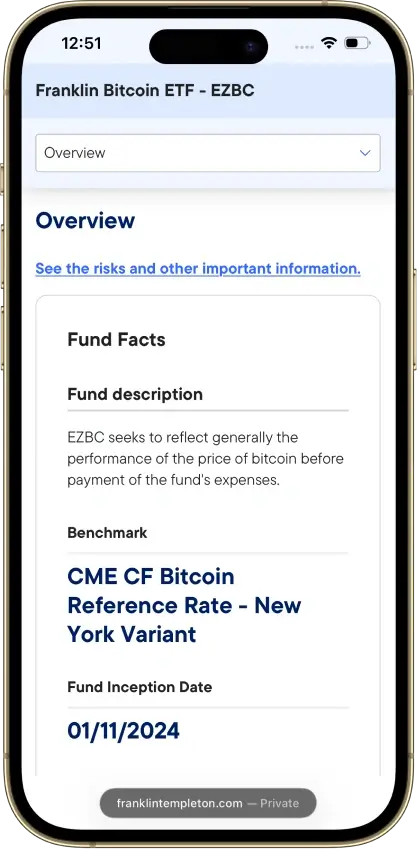
Franklin Bitcoin ETF Overview
- Fund Name
- Franklin Bitcoin ETF
- Ticker
- EZBC
- Listing Exchange
- Cboe BZX
- Fund Family / Issuer
- Franklin Templeton
- Underlying Asset
- Bitcoin
Additional details
- Exposure
- Spot Bitcoin held directly by the fund.
- Fund Structure
- Commodity trust, not registered as an investment company under the Investment Company Act of 1940.
- Annual sponsor fee
- 0.19%
- Fee Assessment Base
- Net asset value.
- Effective Annual Charge
- 0.19%
- Fee Waiver / Conditions
- Franklin shows the same 0.19% gross and net rate. Litigation and other extraordinary expenses can be borne by the fund separately from the sponsor fee.
- Benchmark
- CME CF Bitcoin Reference Rate – New York Variant (BRRNY)
- Custody Appointments
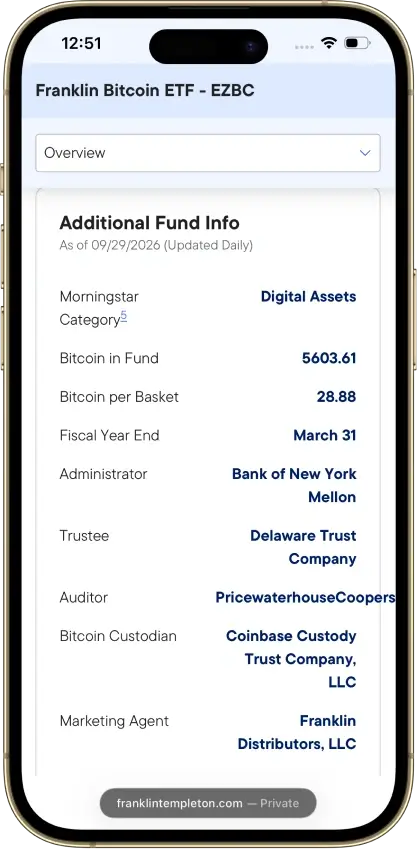
- Coinbase Custody Trust Company, LLC; Bitcoin custodian; Preserves recorded fund ownership and permits negligence-based responsibility. Settlement-credit liens can still reach assets, and the agreement limits recovery.
- Retail Asset Redemption
- Individual shares cannot be redeemed for Bitcoin. Retail investors sell through a broker for cash; authorized participants handle direct creation and redemption.
- 30-day Median Bid/Ask Spread
- 0.05%As of Sep 4, 2026
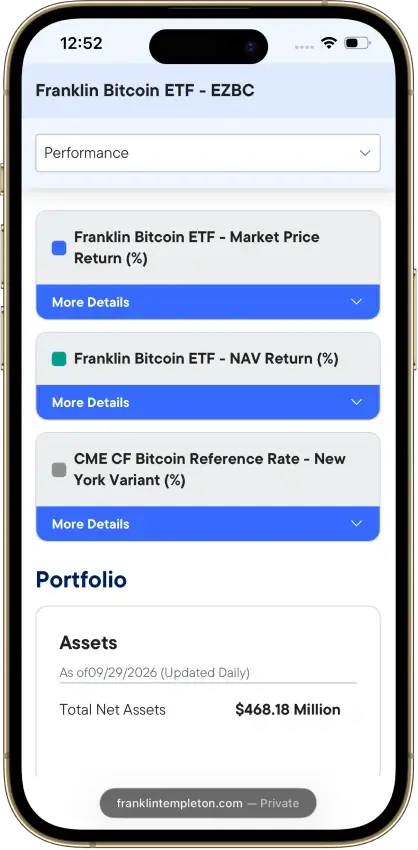
- Fund Assets
- USD 478,930,000As of Sep 21, 2026
Net assets
- Issuer-reported inception
- Jan. 11, 2024
- First exchange trading
- Jan. 11, 2024
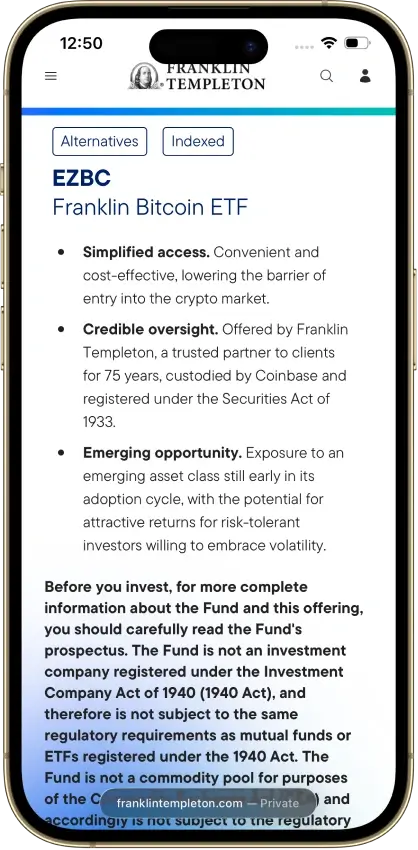
Franklin Bitcoin ETF Screenshots

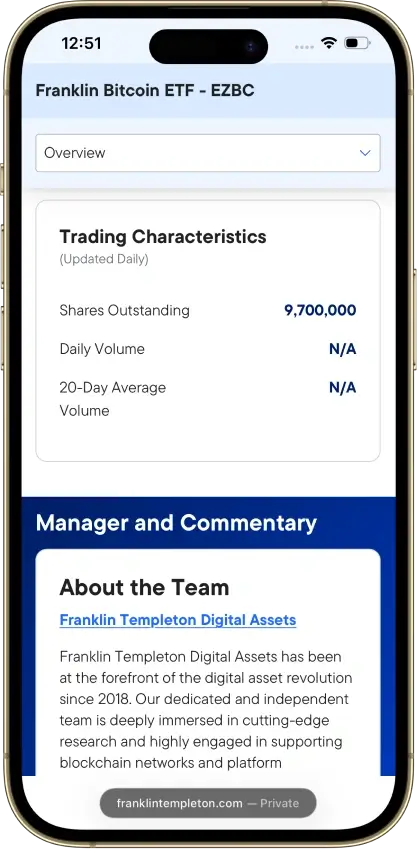
Screenshot 1 of 8
Franklin Bitcoin ETF Pros and Cons
Pros
- Lower sponsor rate than BITB
- No private keys for shareholders to manage
- Buy through an eligible brokerage account
Cons
- Higher sponsor rate than Grayscale BTC
- Bitcoin volatility can cause large losses
- Shares cannot fund a personal Bitcoin wallet
Who EZBC Is For
EZBC can suit investors who have decided to use the fund format for Bitcoin exposure and are assessing Franklin Templeton’s product. The brokerage format lets them hold a security while the fund arranges storage of the underlying asset.
That choice still leaves the investor responsible for how much exposure to Bitcoin belongs in the portfolio. EZBC concentrates its investment exposure in Bitcoin. An investor seeking active management of Bitcoin exposure would need a fund designed for that purpose.
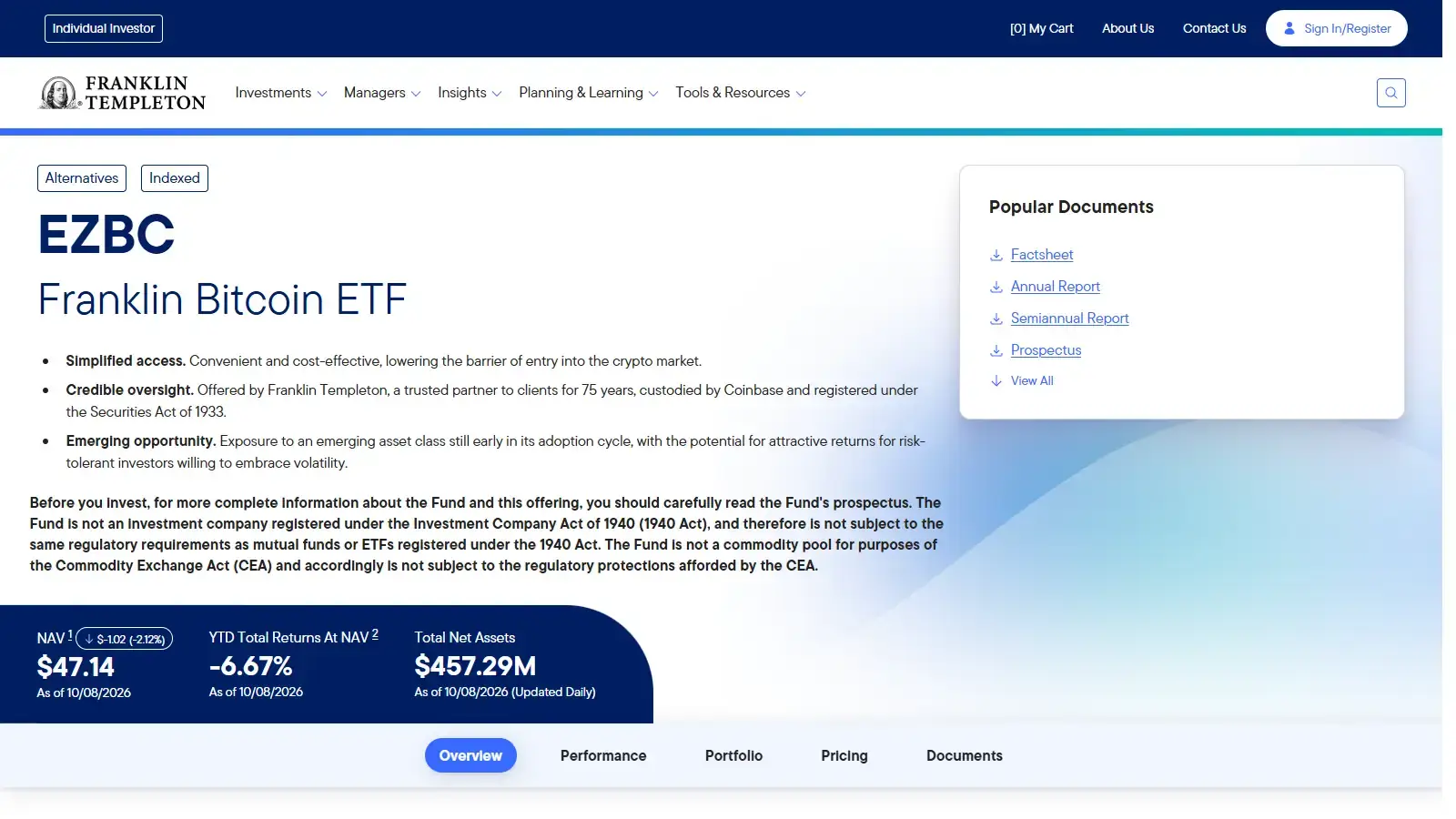
What EZBC Is and How It Works
EZBC owns Bitcoin, and shareholders have a fractional interest in the fund’s net assets. Buying shares does not create a separate balance of withdrawable Bitcoin for the investor. The return comes from changes in the value of the underlying holdings, after expenses.
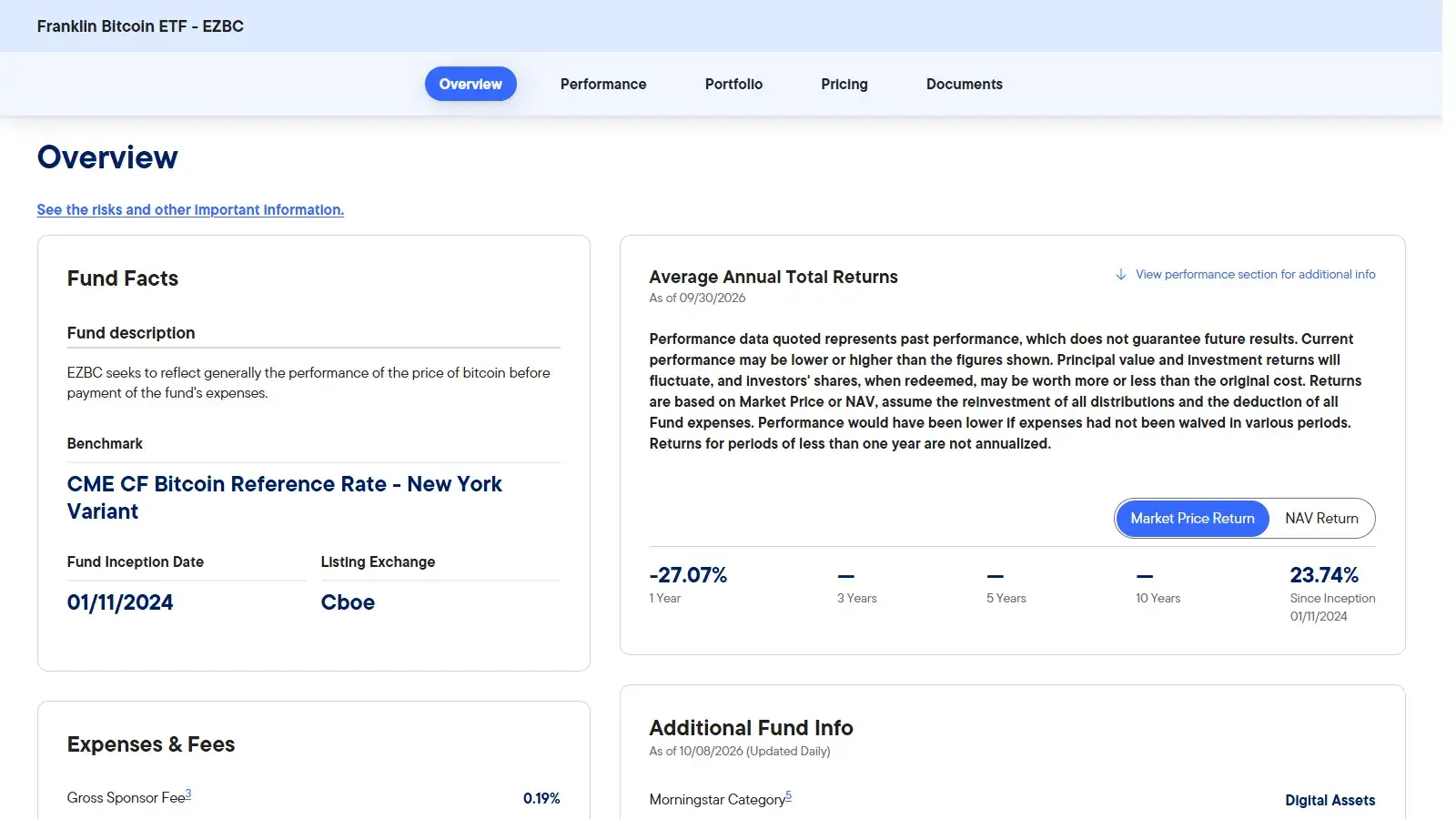
The fund’s inception and first exchange trading both fall on January 11, 2024. Its US shares trade on Cboe BZX under EZBC.
Benchmark and Tracking Comparisons
The CME CF Bitcoin Reference Rate – New York Variant supplies EZBC’s Bitcoin valuation benchmark. The fund’s net asset value (NAV) is calculated by deducting its liabilities from the value of its holdings. To calculate NAV per share, divide those net assets by the outstanding share count.
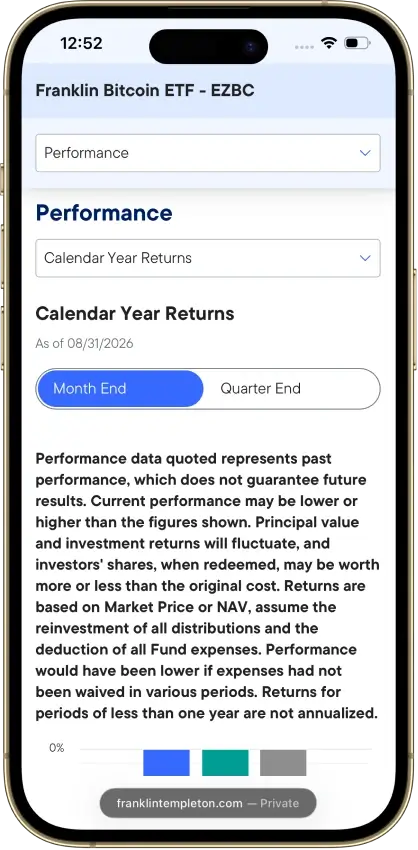
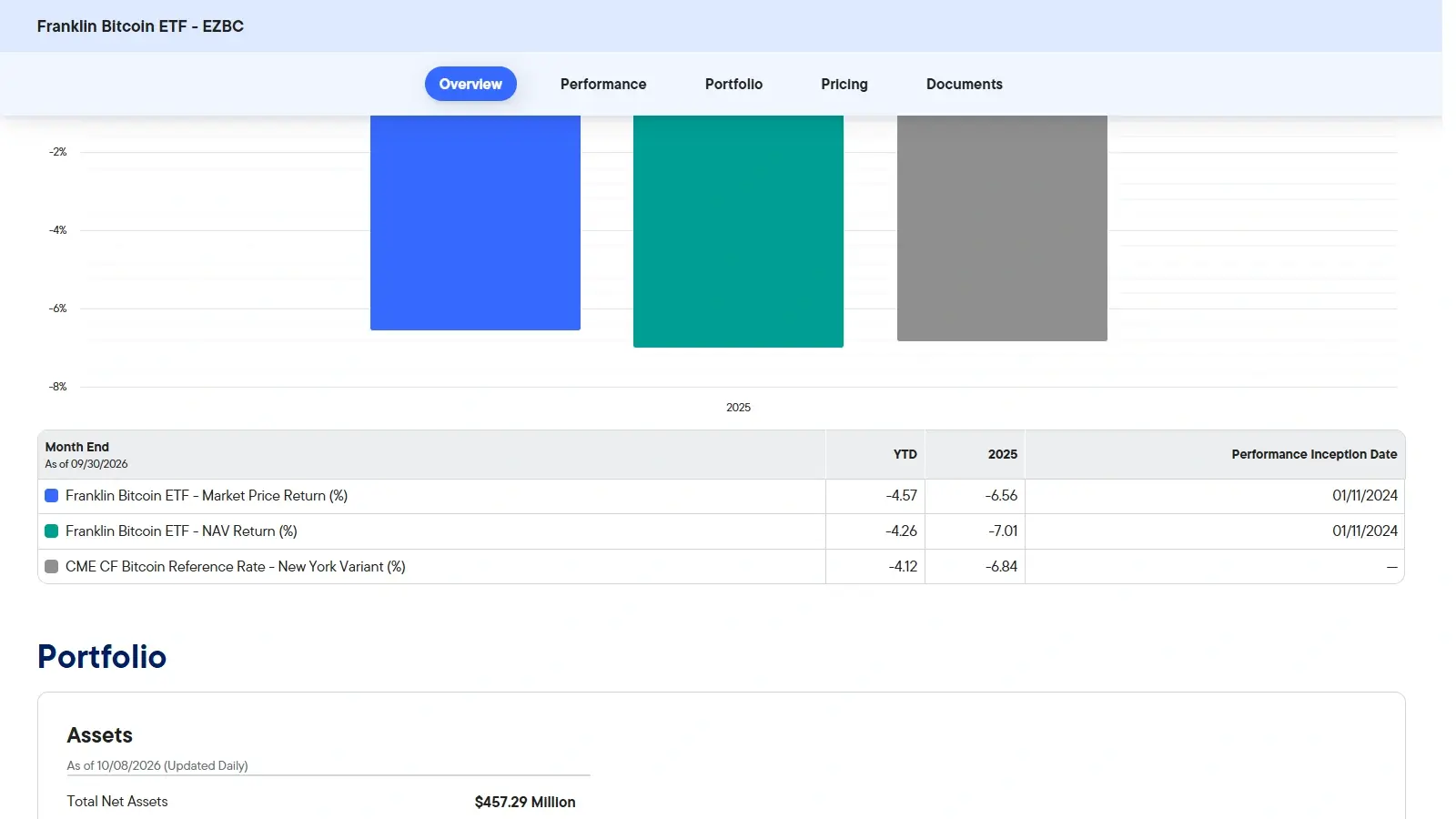
Franklin reports both NAV and market-price returns. NAV returns describe changes in the per-share asset value, while market-price returns follow the prices of the traded security. These can differ when shares trade above or below NAV per share.
A comparison with Bitcoin also needs matching dates and observation times. A return measured from one exchange quote should not be compared with a fund return covering a different interval. The benchmark helps define the valuation reference, but it does not guarantee the price available on a brokerage order.
Is EZBC Safe? Custody and Investment Risks
A steep decline in Bitcoin’s price can cause large losses in EZBC. An investor needs to assess that concentration before weighing the smaller differences in fund charges.
Who Holds EZBC’s Bitcoin?
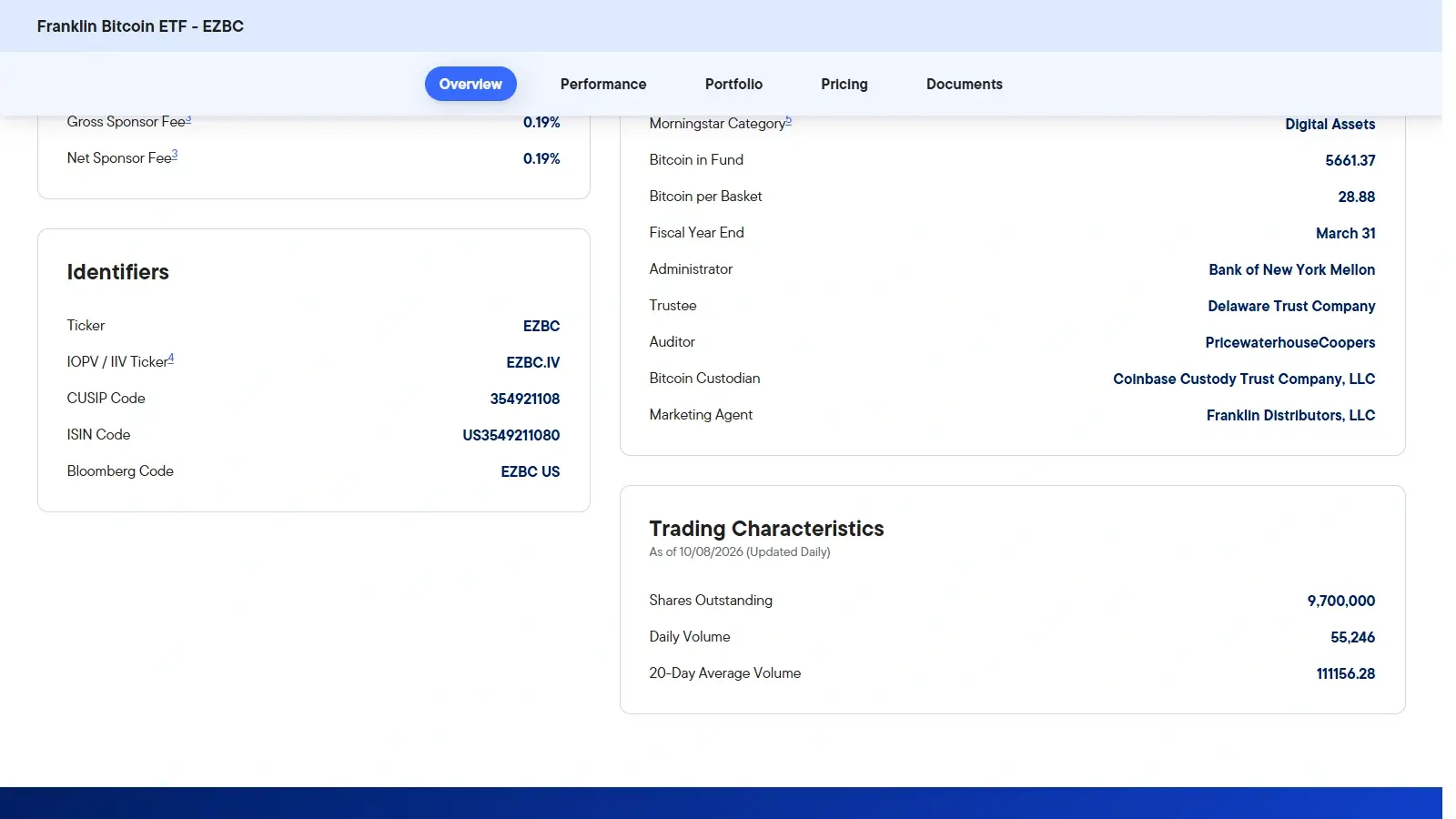
Coinbase Custody Trust Company, LLC is the fund’s disclosed Bitcoin custodian. Shareholders own an interest in the fund and rely on the fund’s custody arrangements for the safekeeping of its Bitcoin.
The custodian handles the private keys used to authorize Bitcoin transfers. Shareholders avoid managing those keys themselves, while remaining exposed to failures involving the fund’s service providers. A named custodian is evidence of an assigned role, not proof that every possible loss would be recovered.
Fund Structure and Regulatory Status
EZBC is a commodity trust, without investment-company registration under the Investment Company Act of 1940. Investors do not receive the protections attached to that form of registration.
Securities-law disclosure and antifraud requirements still apply. Those obligations make information available about the offering and fund operations. They do not insure the investment against Bitcoin losses or a failure affecting the underlying assets.
EZBC Fees and Trading Costs
Franklin lists a 0.19% annual sponsor fee, with the same gross and net rate on its current fund page. This recurring fund charge should be considered alongside the costs that arise when placing or closing a trade.
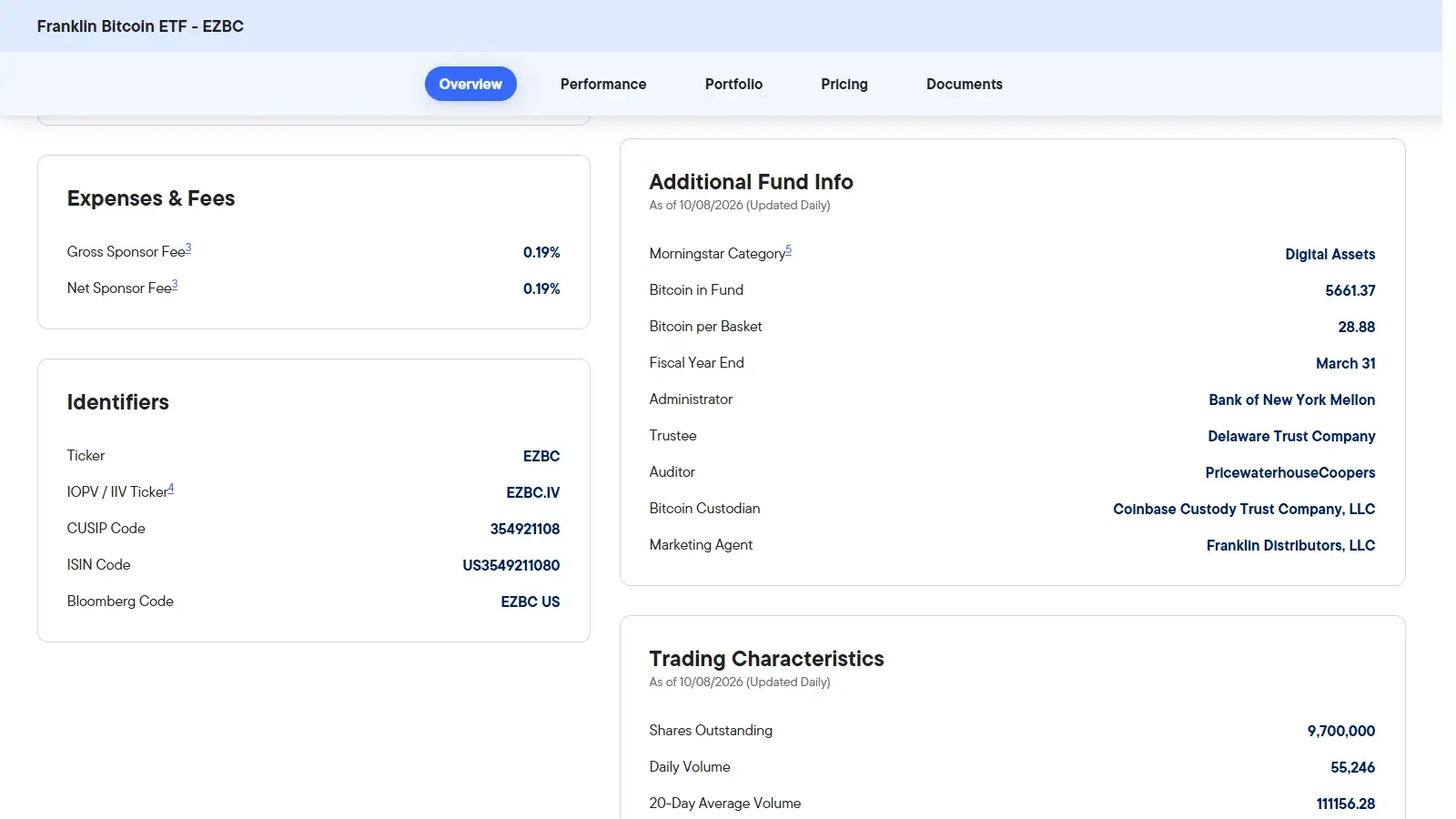
Litigation and other extraordinary expenses can be borne by the fund separately from the sponsor fee.
Paying fund costs leaves each share backed by a smaller quantity of Bitcoin. That coin quantity can decline while the holding’s dollar value rises if Bitcoin appreciates. The sponsor rate measures a fund cost, without setting the investor’s eventual dollar return.
What One Basis Point Means
One basis point equals 0.01 percentage point. EZBC’s 0.19% rate is one basis point below Bitwise Bitcoin ETF (BITB) at 0.20%. Grayscale Bitcoin Mini Trust ETF, whose ticker is BTC, charges 0.15%.
Using a constant $10,000 holding for one year gives a sponsor-fee illustration of $19 for EZBC, $20 for BITB and $15 for Grayscale BTC. EZBC saves $1 relative to BITB and costs $4 more than BTC under that assumption. These figures exclude trading costs and changes in the holding’s value.
To assess a switch from BITB, compare the dollar saving over the intended holding period with the costs of selling and buying.
Buying and Selling EZBC
Check that your broker permits trading in EZBC for the account you intend to use. A research profile and permission to buy the security are separate things. Confirm the ticker, the Franklin Bitcoin ETF name and the US listing before submitting an order.

Comparing an Order With NAV per Share
A live quote may come from a different time than the most recent NAV per share. Compare their timestamps before reading the gap as a premium or discount. A premium means the share price is higher than NAV per share, and a discount means it is lower.
Review both sides of the market and any commission when considering the cost of an order. A historical spread needs to be checked against the quotes available when the investor places the order.
Selling Shares and Receiving Cash
Retail investors normally exit by selling EZBC shares through their broker for cash. Direct creation and redemption transactions with the fund are reserved for authorized participants. Holding individual shares does not give a retail investor a right to demand delivery of the fund’s Bitcoin.
If the intended use involves sending coins to a wallet where you control custody, a separate holding of transferable Bitcoin is needed.
Where to buy EZBC
Explore broker options for Franklin Bitcoin ETF.
United States


Robinhood
U.S. accounts only; account eligibility and product access apply.
Listing: Primary listing (Cboe BZX: EZBC).
Eligibility details for Robinhood
- Account access
- Robinhood Financial LLC self-directed securities brokerage; confirm access in your account
- Eligibility
- U.S. accounts only; account eligibility and product access apply.
- Access notes
- Buy and sell EZBC ETF shares through a U.S. Robinhood brokerage account.
- Listing
- Primary listing (Cboe BZX: EZBC)

Webull
U.S. accounts; account eligibility and product approval requirements apply.
Listing: Primary listing (Cboe BZX Exchange: EZBC).
Eligibility details for Webull
- Account access
- Webull Financial LLC; self-directed brokerage, subject to account trading permissions
- Eligibility
- U.S. accounts; account eligibility and product approval requirements apply.
- Access notes
- Buy and sell EZBC ETF shares through a U.S. Webull brokerage account.
- Listing
- Primary listing (Cboe BZX Exchange: EZBC)
Availability depends on country and account.
EZBC Alternatives
BITB is a close recurring-fee comparison, while Grayscale BTC shows that EZBC is not the lowest-priced fund among these three. Each holds spot Bitcoin. The differences below concern the listed products and their published terms.
EZBC vs BITB and Grayscale BTC
| Feature | EZBC | BITB | Grayscale BTC |
|---|---|---|---|
| Fund family | Franklin Templeton | Bitwise | Grayscale |
| Annual sponsor fee | 0.19% | 0.20% | 0.15% |
| US listing | Cboe BZX | NYSE Arca | NYSE Arca |
| Exposure | Spot Bitcoin | Spot Bitcoin | Spot Bitcoin |
EZBC and BITB both name Coinbase Custody for Bitcoin safekeeping. They can therefore share exposure to a custody problem at that provider.
Investors can weigh the four-basis-point saving in Grayscale BTC against their reasons for preferring Franklin’s fund. Neither the provider’s name nor the sponsor rate establishes future investment results.
Bitcoin ETFs Pillar Scores
- Fund fees 30% weight Ongoing sponsor charge before temporary waivers, fee basis, covered expenses, extra fund costs, and waiver terms.8.4 / 10
- Trading spread 25% weight Median difference between bid and ask prices over 30 days.9.0 / 10
- Fund size 10% weight Value of the fund’s assets.6.0 / 10
- Custody & asset rights 20% weight Fund ownership, separate asset records, and the custodian's contractual responsibility for its own safekeeping failures.10.0 / 10
- Reporting & transparency 15% weight Required reports, public holdings, valuation benchmark, net asset value (NAV), and management's disclosure-control conclusions.10.0 / 10
Final Verdict
EZBC offers Franklin Templeton’s spot Bitcoin exposure with a 0.19% annual sponsor fee. Its recurring charge is slightly below BITB’s, but the difference is just $1 a year on a constant $10,000 holding, before trading costs. Grayscale BTC remains cheaper on that same measure. The size of these gaps makes a dollar-based comparison more useful than a fee ranking alone. The fund can serve investors who want Bitcoin exposure through brokerage shares and accept Coinbase custody. Its passive mandate leaves them exposed to Bitcoin’s volatility, and shareholders cannot take the underlying coins into a personal wallet. Choose the fund format only if those ownership and risk limits fit the intended use.
Best For
Brokerage investors weighing Franklin’s 0.19% rate against execution costs and comfortable with Coinbase custody.
Avoid If
- You require personal control of Bitcoin or expect the fund to adjust its exposure during market downturns.
Disclaimer: CryptoSlate may receive a commission when you click links on our site and make a purchase or complete an action with a third party. This does not influence our editorial independence, reviews, or ratings, and we always aim to provide accurate, transparent information to our readers.