



Grayscale Ethereum Staking Mini ETF Overview
- Fund Name
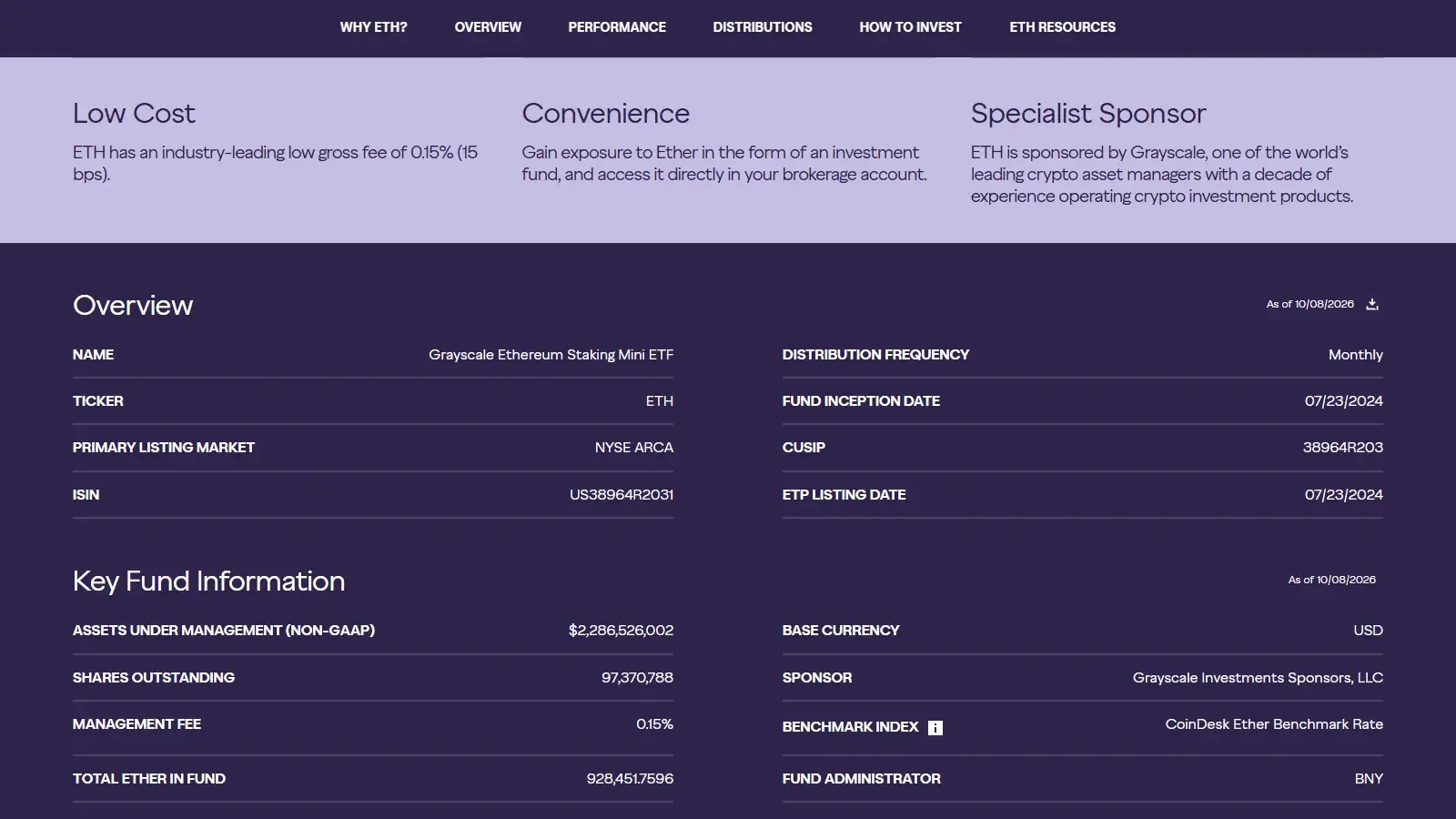
- Grayscale Ethereum Staking Mini ETF
- Ticker
- ETH
- Listing Exchange
- NYSE Arca
- Fund Family / Issuer
- Grayscale
- Underlying Asset
- Ethereum
Additional details
- Exposure
- Spot ether held by the trust, most of it staked.
- Fund Structure
- Delaware statutory trust, not registered as an investment company under the Investment Company Act of 1940.
- Annual sponsor fee
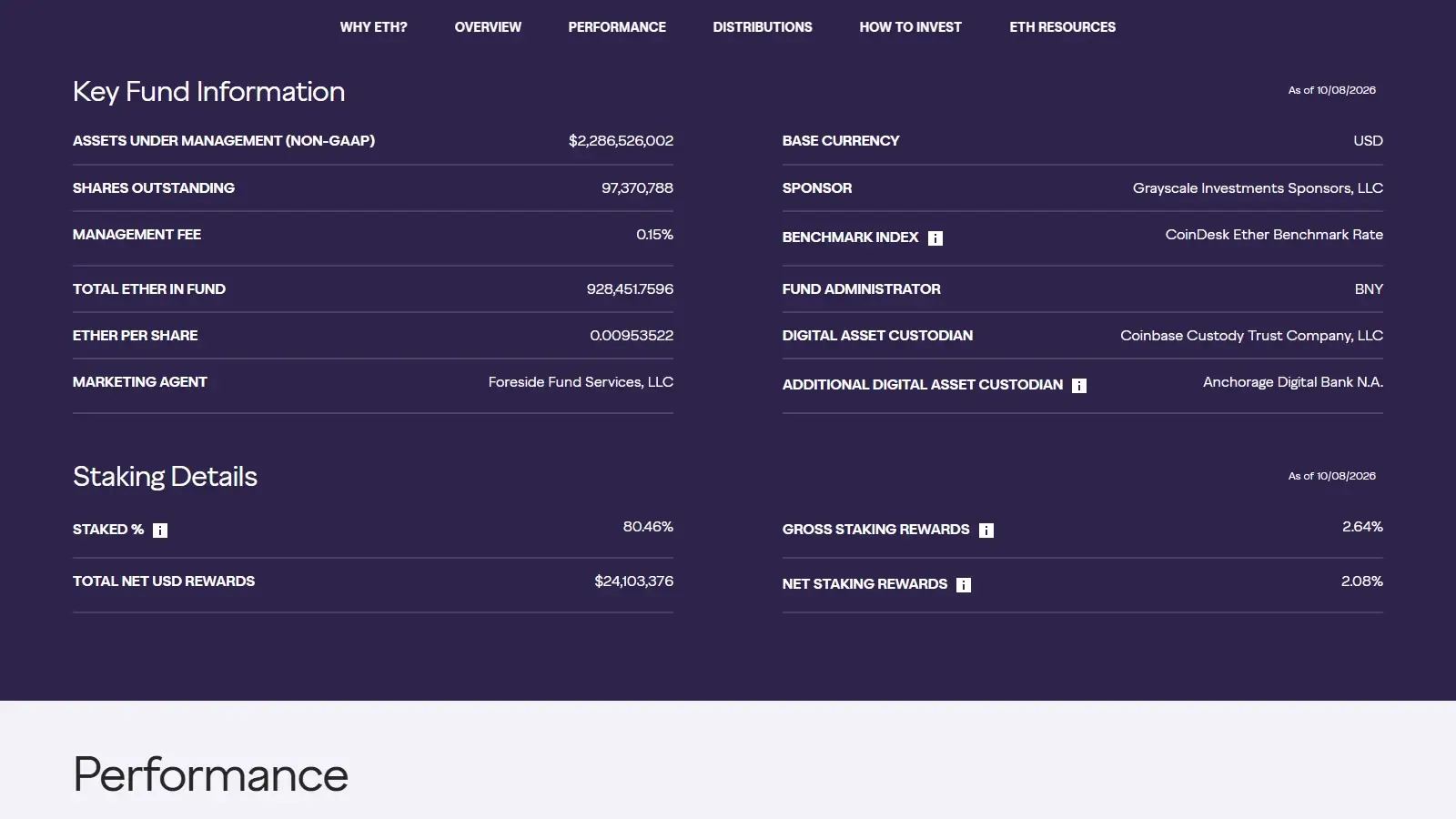
- 0.15%
- Fee Assessment Base
- NAV Fee Basis Amount, as defined for the sponsor fee.
- Effective Annual Charge
- 0.15%
- Benchmark
- CoinDesk Ether Benchmark Rate
Effective from Apr 1, 2026
- Custody Appointments
- Coinbase Custody Trust Company; Primary ether custodian; Holds the ether as the trust’s property and is liable for losses caused by its negligence, with a duty to replace lost ether. Its staking addendum gives no recourse for slashing losses.Anchorage Digital Bank; Additional ether custodian; Holds the ether as the trust’s property and is liable for losses caused by its negligence, with a duty to replace lost ether.
- Retail Asset Redemption
- Individual shareholders cannot redeem shares for ether sent to a wallet. Authorized participants create and redeem blocks of 10,000 shares with the trust, in cash or in ether.
- 30-day Median Bid/Ask Spread
- 0.04%As of Sep 23, 2026
- Fund Assets
- USD 2,500,991,993As of Sep 24, 2026
Net assets (GAAP)
- Former name
- Grayscale Ethereum Mini Trust
- Staking began
- Oct. 6, 2025
- Share of ether staked
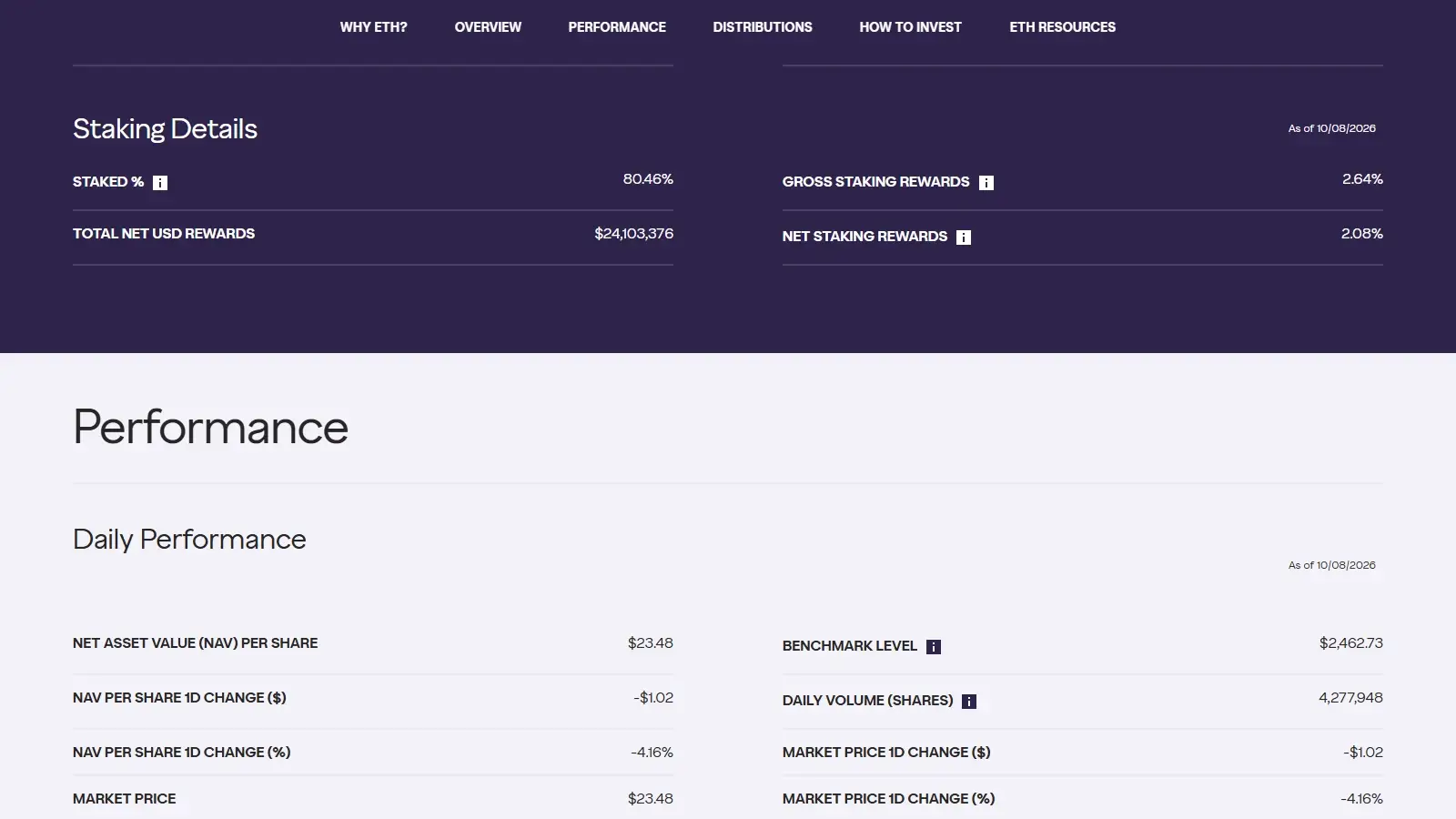
- 77.00% as of Sep. 24, 2026, including ether waiting to activate or exit
- Staking providers
- Validators approved by Coinbase under its staking addendum. Their names are not public.
- Staking rewards
- The trust receives 94% of gross rewards and pays out the net cash proceeds. The sponsor, custodian and provider share the other 6%.
- Withdrawal and redemption effect
- A portion of ether stays unstaked for redemptions. Staked ether must leave the network’s exit queue before it can be sold.
- Other investor costs
- 6% of gross staking rewards, bid-ask spread and any broker charges
- First exchange trading
- July 23, 2024
- Official website
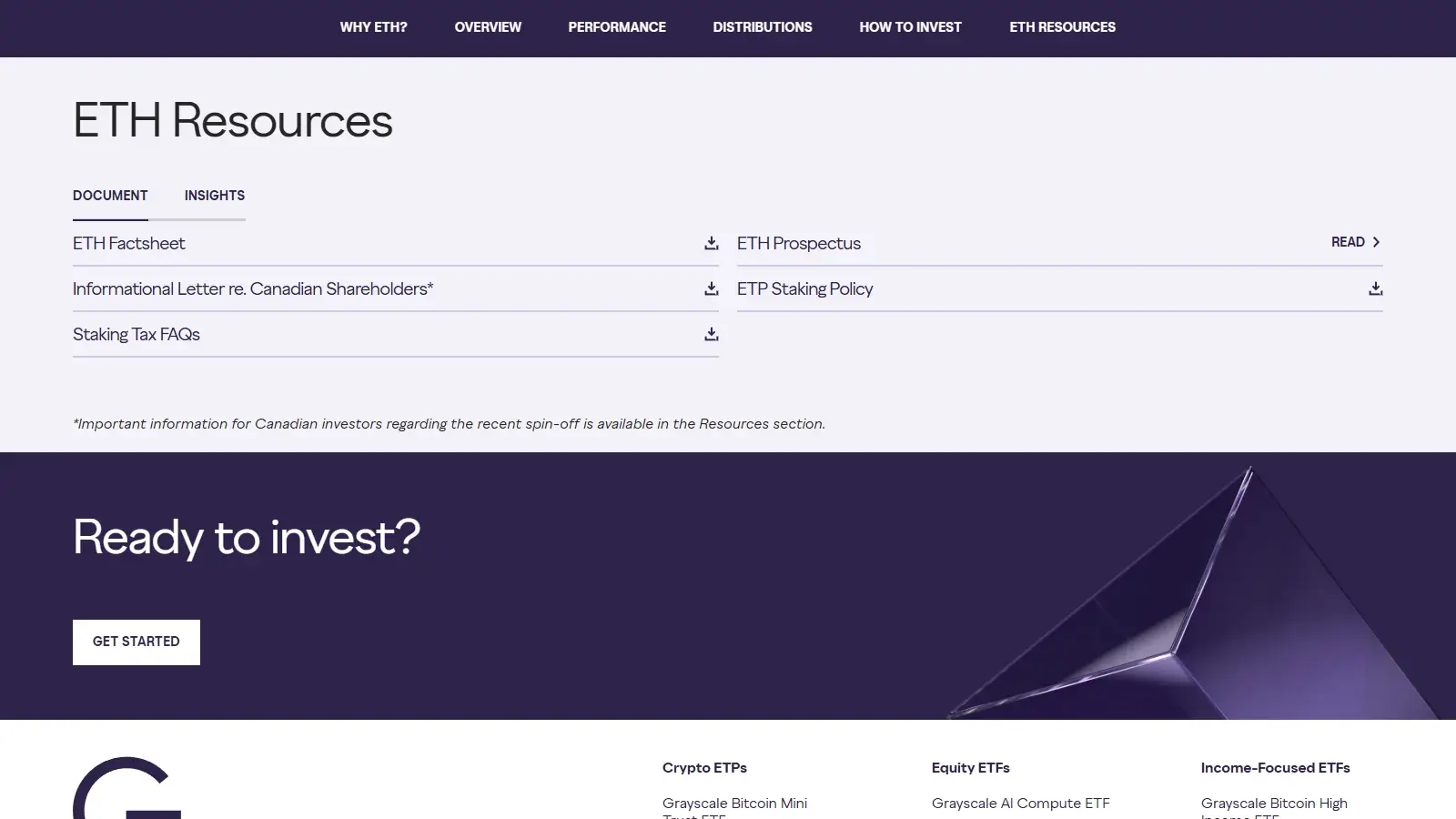
- Grayscale ETH fund page
Grayscale Ethereum Staking Mini ETF Screenshots
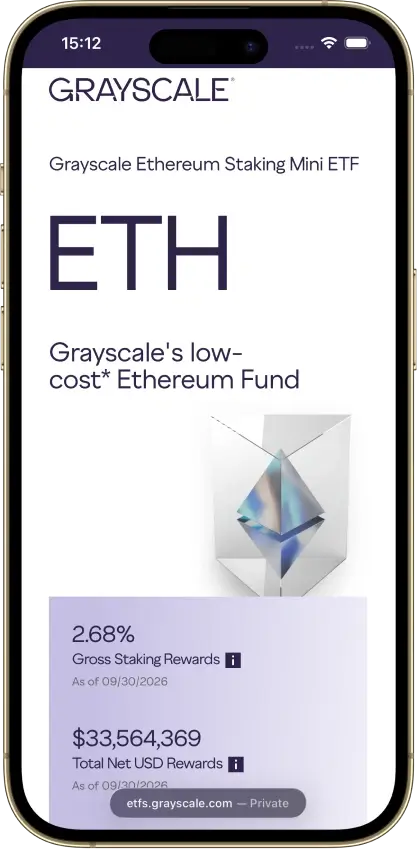

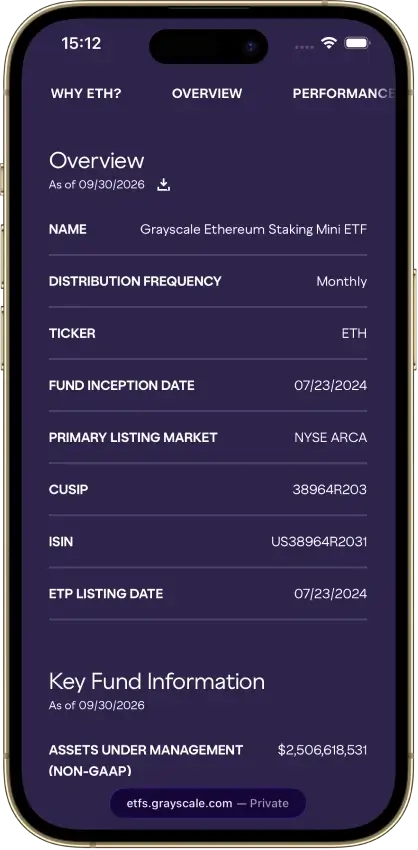
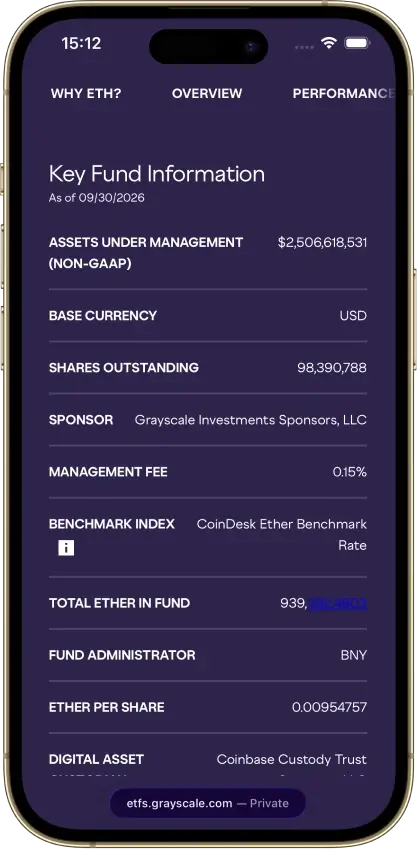
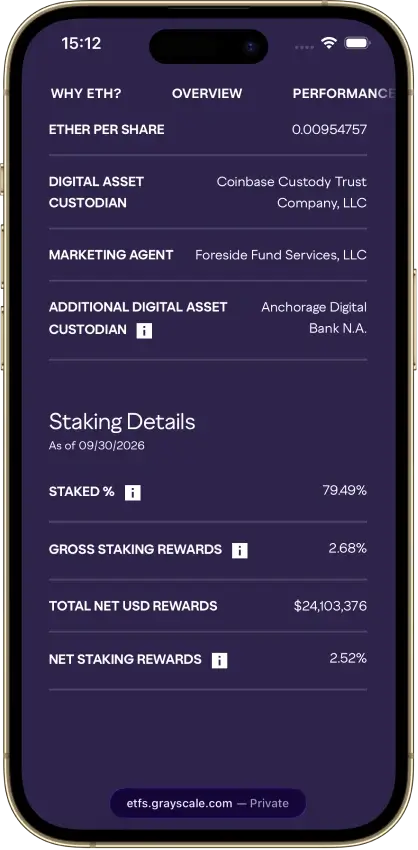
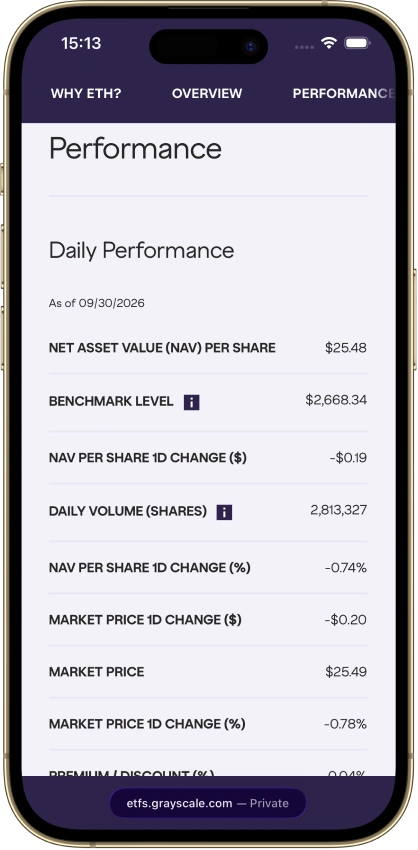
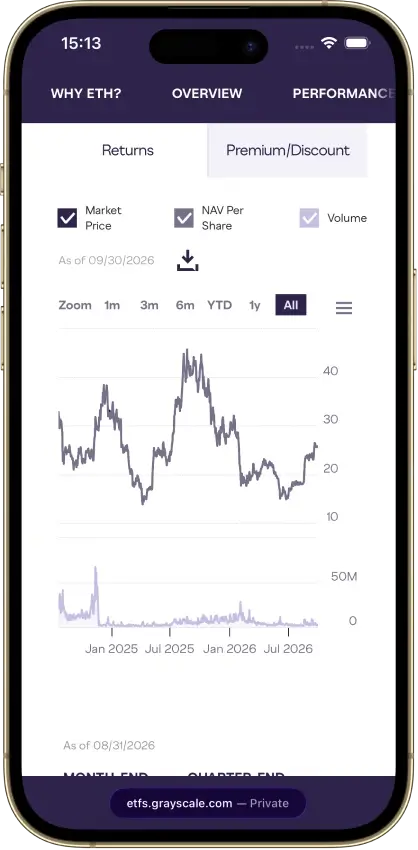

Screenshot 1 of 8
Grayscale Ethereum Staking Mini ETF Pros and Cons
Pros
- Cash-distribution policy for net rewards
- Staked share published daily
- Custodians liable for negligent loss
Cons
- No public repayment terms for slashing
- No ether withdrawals to your wallet
- Sponsor can change its staking cut
Who ETH Is For
ETH suits investors who want ether exposure and the extra return from staking, held as a security in a brokerage account.
What ETH Is and How It Works
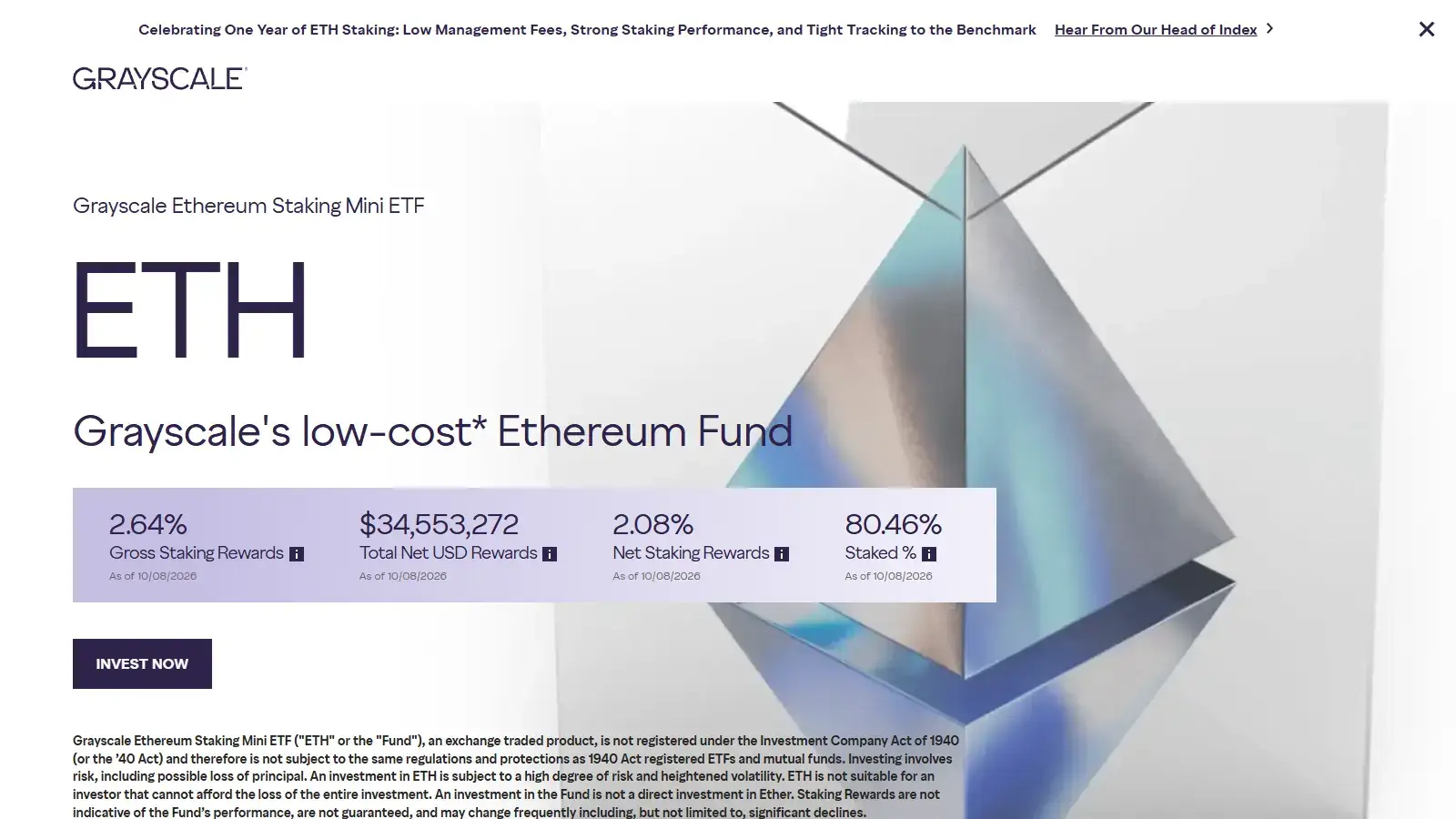
ETH holds ether so that its shares follow ether’s price, less expenses, and it adds the staking rewards the trust receives. It holds ether itself and uses no futures contracts.
Shareholders own an interest in the trust. They can hold and trade that security, but they do not control the private keys to its ether.
Benchmark and How to Check Tracking
Since April 1, 2026, ETH has valued its ether using the CoinDesk Ether Benchmark Rate. Before that it used the CoinDesk Ether Price Index. The benchmark sets a daily reference price used to calculate net asset value.
Net asset value, or NAV, is the value of the trust’s assets after liabilities, divided by the number of shares. To judge tracking, compare the fund’s NAV return with the benchmark over matching dates. Staking rewards are paid out as cash distributions, so NAV alone understates what a shareholder earned. To see what staking added, compare total return, including distributions, with the NAV return.
How ETH Stakes Its Ether
ETH began staking on October 6, 2025. Staking commits ether to validators that help run the Ethereum network, which pays rewards for that work.
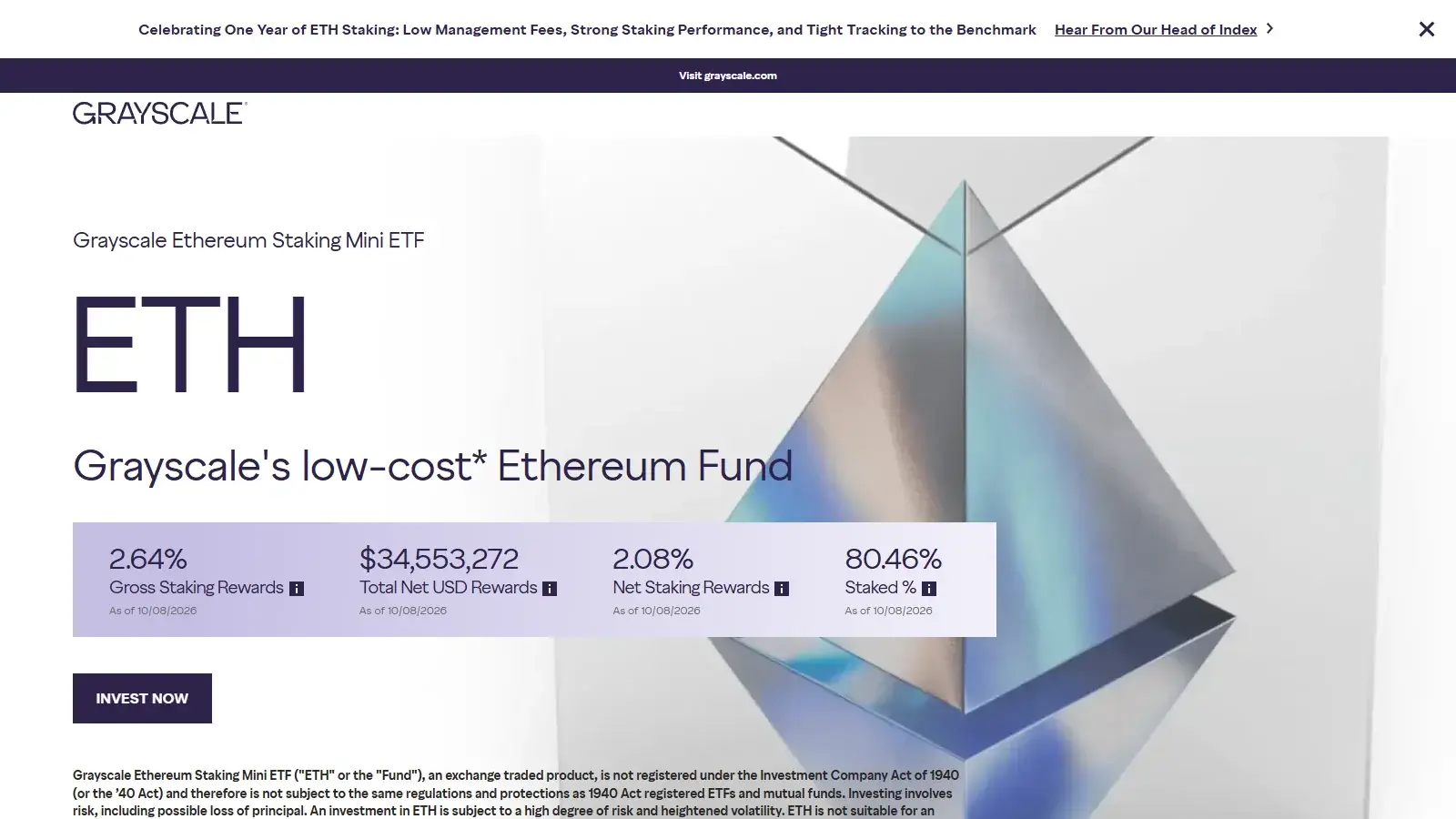
Grayscale’s reward rates are measured on staked assets only. With 77% staked, the 2.54% net rate works out to roughly 1.96% across all of the fund’s ether (2.54% × 0.77).
The sponsor keeps a “Liquidity Sleeve” of unstaked ether to meet redemptions. Staked ether is unstaked only after a redemption is approved and the Ethereum network processes the exit, which can take days or longer when the exit queue is busy.
Is ETH Safe? Custody and Investment Risks
A fall in ether’s market price can reduce an ETH holding far faster than staking rewards of about 2.5% a year on the staked share can make up. The exchange listing offers no protection against that price risk.
Who Holds ETH’s Ether?
Coinbase Custody Trust Company is the custodian, and Anchorage Digital Bank is an additional custodian. Both agreements hold the ether as the trust’s property, separate from the custodian’s own assets. Each makes the custodian liable for losses caused by its negligence and requires it to replace lost ether.
Staking adds parties with access to the trust’s ether. Coinbase’s staking addendum lets validators it approves stake the trust’s ether. If a validator is slashed, the loss comes out of the trust’s account. Coinbase passes on any compensation a validator chooses to pay, and it states it has “no liability to Client whatsoever” for the rest. The validator schedules that might promise more are filed with their terms blacked out.
Fund Structure and Regulatory Status
ETH is a Delaware statutory trust and is not registered under the Investment Company Act of 1940. Calling it an ETF does not give it the protections of a fund registered under that act. Grayscale intends to treat the trust as a grantor trust for US federal income tax purposes.
ETH Fees and Trading Costs
Besides the 0.15% sponsor fee, ETH withholds part of its staking rewards, and trading the shares adds costs of its own.
Applying 0.15% to a hypothetical $10,000 held at a constant value for a full year gives $15. At the 2.6178% reference staking rate, the 6% cut on 77% staked ether adds about $12, for roughly $27 in total. Your costs move with the value of the holding and the network’s staking rate, and trading costs come on top.
Grayscale cut the fee to 0% on the first $2 billion of assets for six months after launch. That waiver ended on January 23, 2025, and no waiver applies now.
Buying and Selling ETH
ETH trades on NYSE Arca under the ticker ETH. Brokerage access varies by account and location. Confirm the fund’s full name and ticker in your account before placing an order, since “ETH” is also the common shorthand for ether itself.
Share Price and NAV
The share price can sit above NAV, called a premium, or below it, called a discount. When authorized participants create or redeem shares with the trust, the market price tends to move back toward NAV. Check the current bid and ask prices and any broker commission before you trade.
Ether Withdrawals and Retail Shares
Buying a share does not put ether into a wallet you control. Retail investors buy and sell shares on the market. Authorized participants create and redeem blocks of 10,000 shares with the trust, in cash or in ether. That process gives an ordinary shareholder no way to withdraw ether personally.
Where to buy ETH
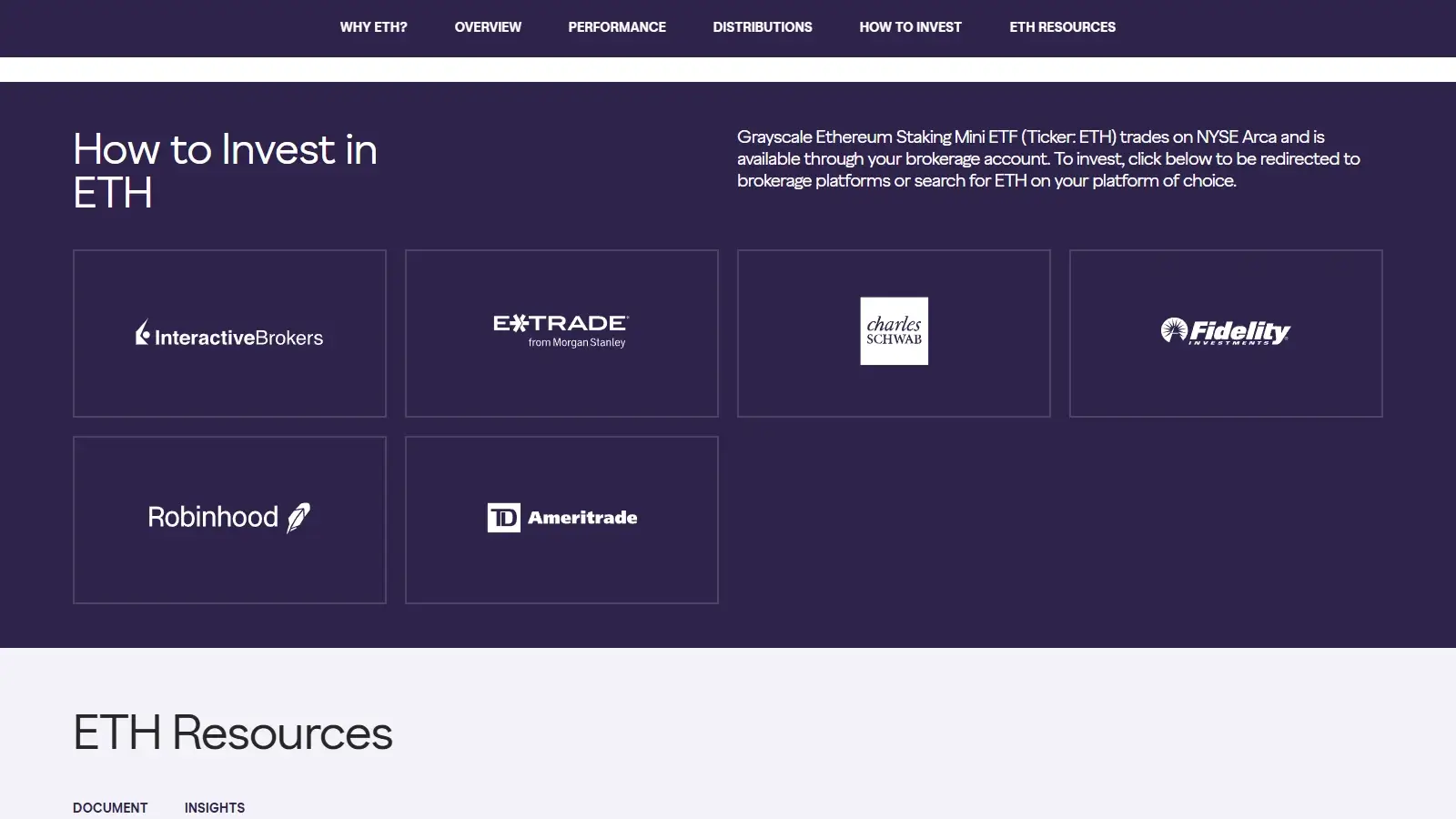
Explore broker options for Grayscale Ethereum Staking Mini ETF.
ETH — NYSE Arca · United States


Robinhood
U.S. accounts, subject to account eligibility and trading permissions.
Eligibility details for Robinhood
- Account access
- U.S. self-directed securities brokerage through Robinhood Financial LLC; check IRA and fractional-share eligibility in your account
- Eligibility
- U.S. accounts, subject to account eligibility and trading permissions.
- Access notes
- Trade ETH shares through Robinhood’s U.S. securities brokerage.

Webull
U.S. accounts, subject to account eligibility and trading permissions.
Eligibility details for Webull
- Account access
- U.S. self-directed securities brokerage through Webull Financial LLC; check IRA and fractional-share eligibility in your account
- Eligibility
- U.S. accounts, subject to account eligibility and trading permissions.
- Access notes
- Trade ETH shares through Webull’s U.S. securities brokerage.
Availability depends on country and account.
ETH Alternatives
Staking ether yourself lets you choose the validator and hold the keys, with full responsibility for the wallet. A staking service runs the validator for you, under its own terms.
ETH vs ETHE
ETH and the older Grayscale Ethereum Staking ETF (ETHE) share a sponsor, custodians and staking arrangement. The main difference is cost, and ETHE also stakes a slightly larger share of its ether.
| Comparison | ETH | ETHE |
|---|---|---|
| Annual sponsor fee | 0.15% | 2.50% |
| Cut of gross staking rewards | 6% | 23% |
| Share staked (Sep. 24, 2026) | 77.00% | 80.14% |
| Combined cost at the reference staking rate | 0.271% | 2.983% |
Both use the same Coinbase staking addendum and custody agreements. ETHE charges a higher sponsor fee and withholds more of its gross staking rewards.
Ethereum ETF Pillar Scores
- Fund fees 24% weight Ongoing sponsor charge before temporary waivers, fee basis, covered expenses, extra fund costs, and waiver terms.8.8 / 10
- Trading spread 20% weight Median difference between bid and ask prices over 30 days.9.2 / 10
- Fund size 8% weight Value of the fund’s assets.10.0 / 10
- Staking & reward sharing 20% weight Share of fund ETH staked and the share of gross staking rewards retained for shareholders after all reward deductions.7.2 / 10
- Custody & asset rights 16% weight Fund ownership, asset records, custody-loss liability, withdrawal rights, and recourse for provider-caused slashing.8.0 / 10
- Reporting & transparency 12% weight Required reports, public ETH and staking holdings, benchmark, NAV, and management's disclosure-control conclusions.10.0 / 10
Final Verdict
The Grayscale Ethereum Staking Mini ETF gives brokerage-account investors ether exposure plus most of the staking rewards on it. Its 0.15% fee and 6% staking cut add up to 0.271% a year at the reference staking rate, against 2.983% for Grayscale’s older ETHE, and it publishes its staked share daily. Coinbase takes no liability for slashing, and the validator terms that might cover it are not public, so a slashing loss comes out of the trust’s ether unless a validator chooses to compensate it. That is ETH’s main weakness. ETH is a poor fit for anyone who needs ether they can withdraw, or who wants a say in how it is staked.

Best For
Investors who want ether exposure plus staking rewards in a brokerage account at a low fee.
Avoid If
- You need to withdraw ether, choose your own validator, or want recourse for slashing losses.
CryptoSlate may earn a commission when you use partner links, at no extra cost to you. Our reviews, ratings, and editorial decisions remain independent of advertisers. Read How CryptoSlate Makes Money for funding details.