



21Shares Ethereum Staking ETF Overview
- Fund Name
- 21Shares Ethereum Staking ETF
- Ticker
- TETH
- Listing Exchange
- Cboe BZX
- Fund Family / Issuer
- 21Shares
- Underlying Asset
- Ethereum
Additional details
- Exposure
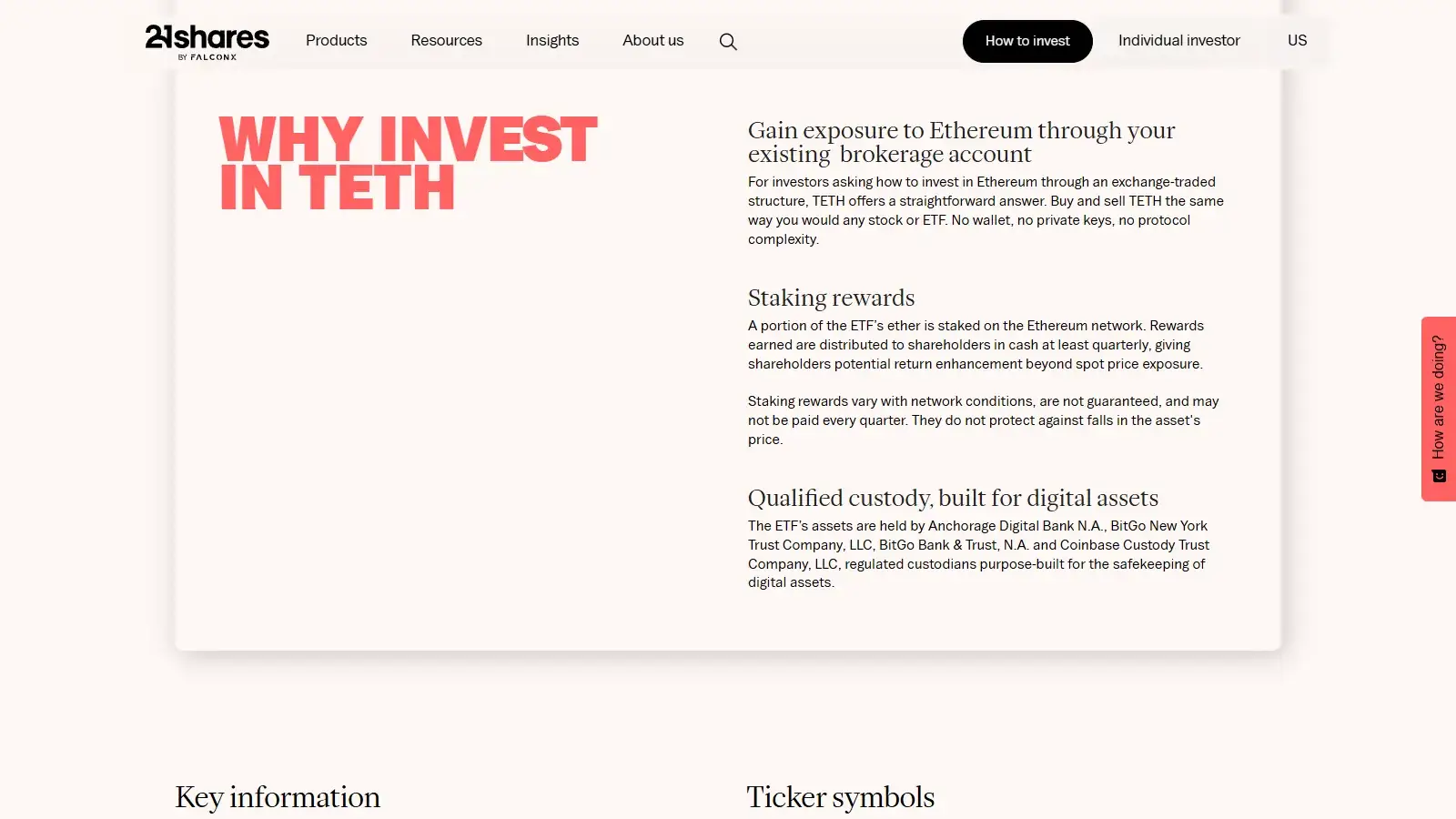
- Spot ether held by the trust, part of it staked.
- Fund Structure
- Delaware statutory trust, not registered as an investment company under the Investment Company Act of 1940.
- Annual sponsor fee
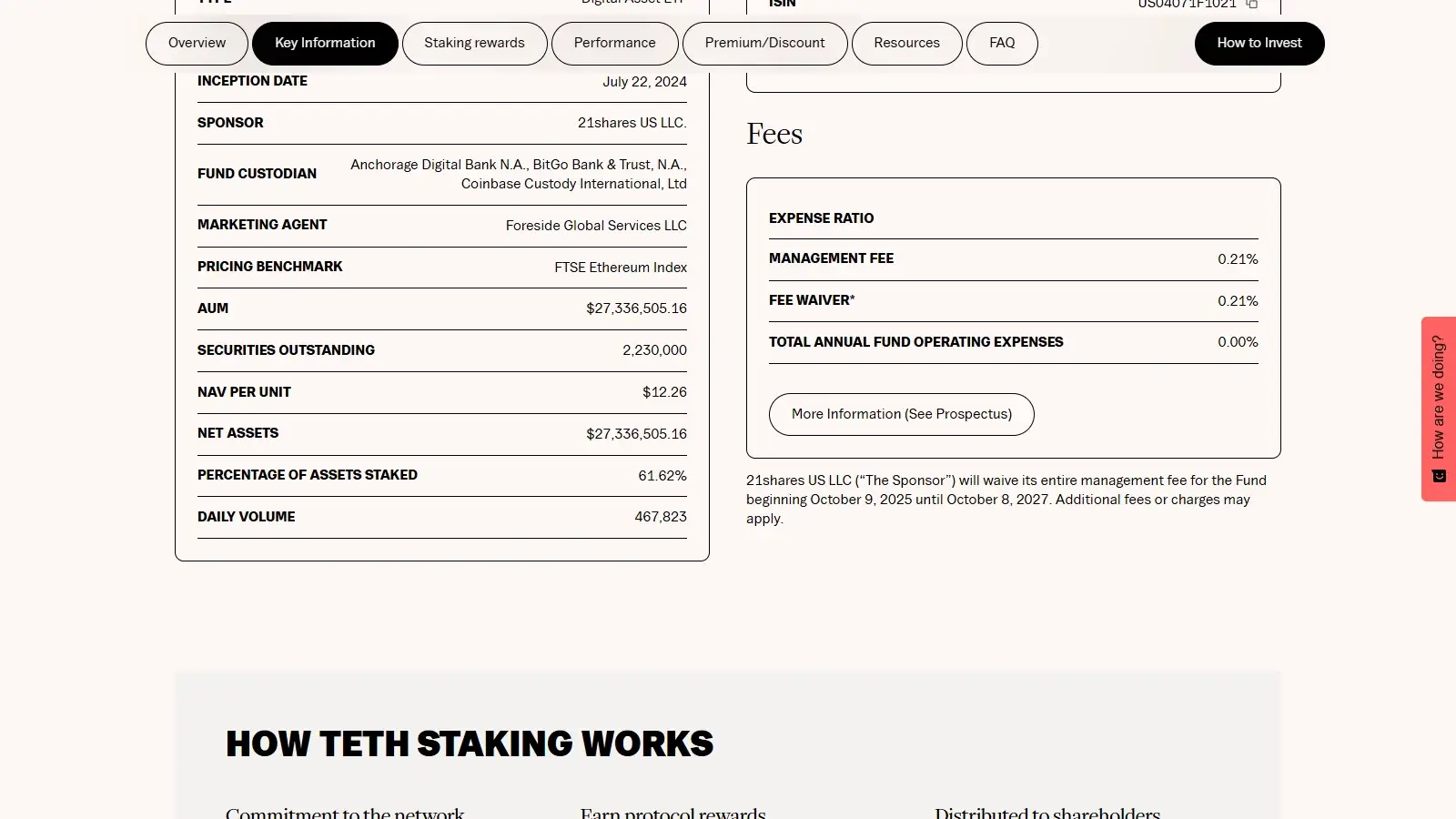
- 0.21%
- Fee Assessment Base
- The trust’s ether holdings, as defined for the sponsor fee.
- Effective Annual Charge
- 0%
- Fee Waiver / Conditions
- Sponsor fee waived to 0% through October 8, 2027. Ongoing annual sponsor fee: 0.21%. The waiver does not cover deductions from staking rewards.
- Benchmark
- FTSE Ethereum Index
Effective from Aug 27, 2026
- Custody Appointments
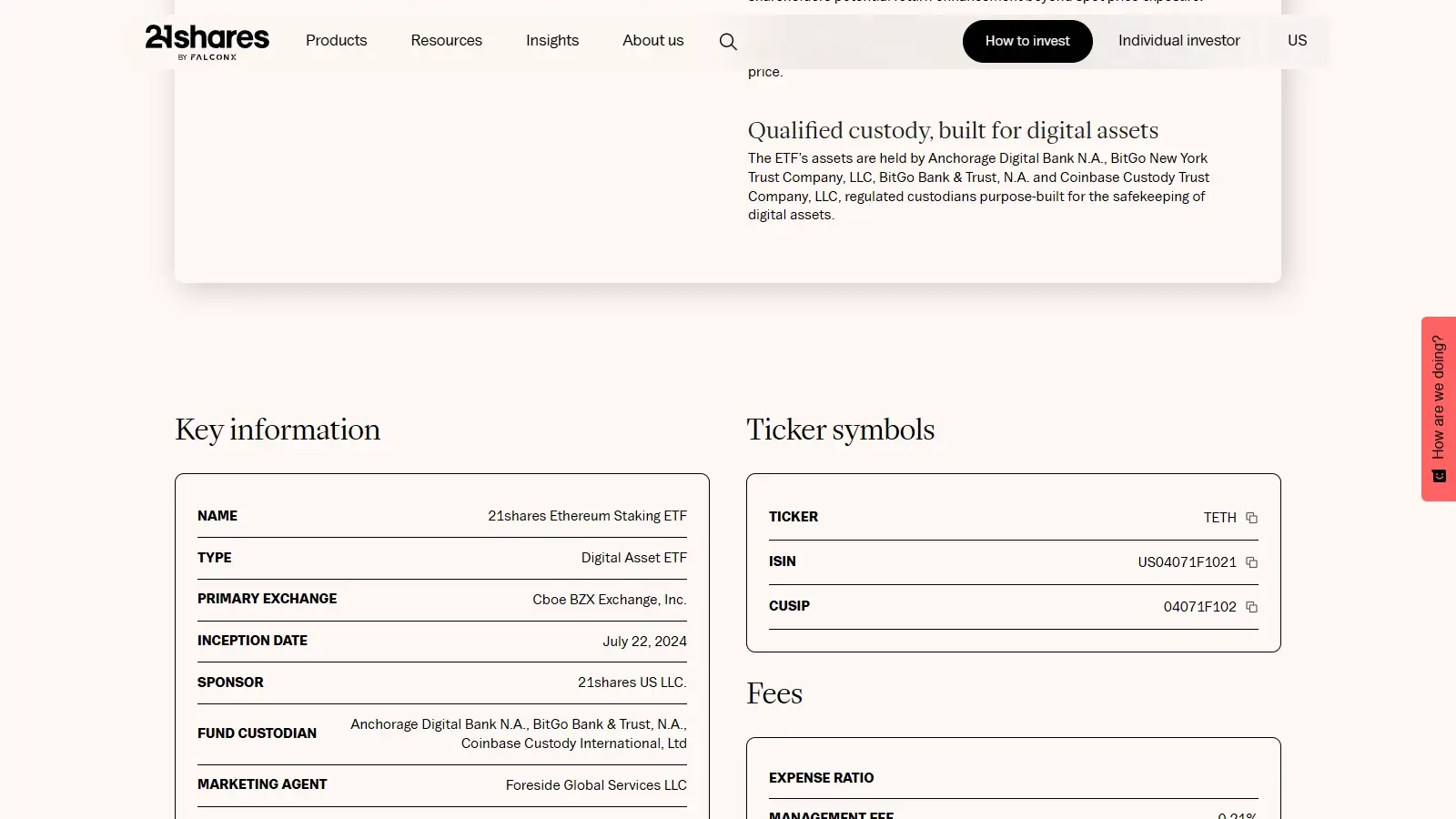
- Coinbase Custody Trust Company; Primary ether custodian; Holds the ether as the trust’s property and is liable only for gross negligence, willful misconduct or fraud.BitGo Bank & Trust; Additional ether custodian; Holds the ether as the trust’s property and is liable only for gross negligence, willful misconduct or fraud.BitGo New York Trust Company; Additional ether custodian; Holds the ether as the trust’s property and is liable only for gross negligence, willful misconduct or fraud.Anchorage Digital Bank; Additional ether custodian; Holds the ether as the trust’s property and is liable only for gross negligence, willful misconduct or fraud.
- Retail Asset Redemption
- Individual shareholders cannot redeem shares for ether sent to a wallet. Authorized participants create and redeem blocks of shares with the trust.
- 30-day Median Bid/Ask Spread
- 0.08%As of Oct 9, 2026
- Fund Assets
- USD 27,607,151.17As of Oct 9, 2026
Daily net assets
- Staking providers
- Coinbase Crypto Services, Figment and Twinstake, each under a direct agreement with the trust
- Share of ether staked
- 61.62% as of October 9, 2026
- Staking rewards
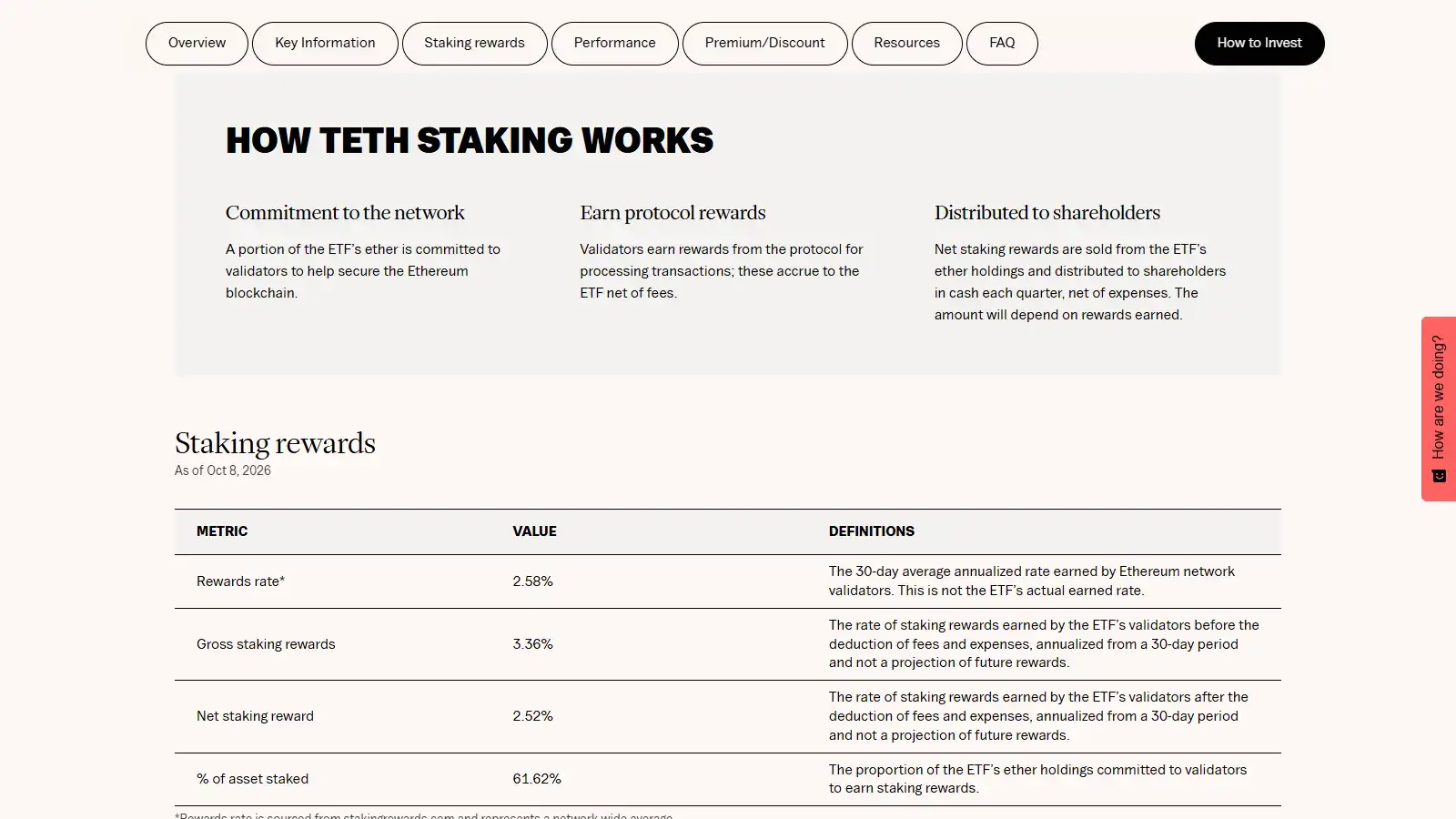
- The sponsor’s 25% staking fee covers the providers’ share. The trust receives the other 75%.
- First exchange trading
- July 23, 2024
- Other investor costs
- 25% of gross staking rewards, bid-ask spread and any broker charges
- Official website
- 21Shares TETH fund page
21Shares Ethereum Staking ETF Screenshots
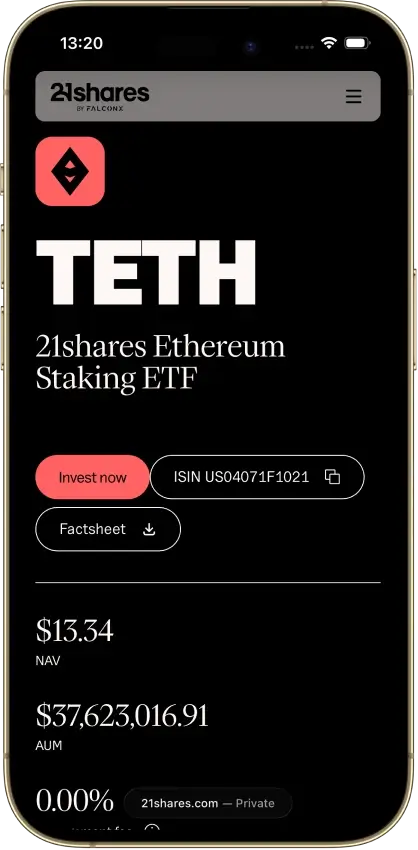
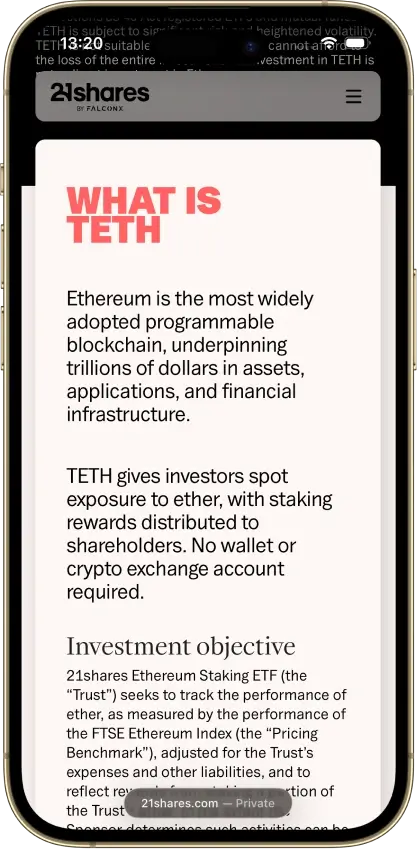
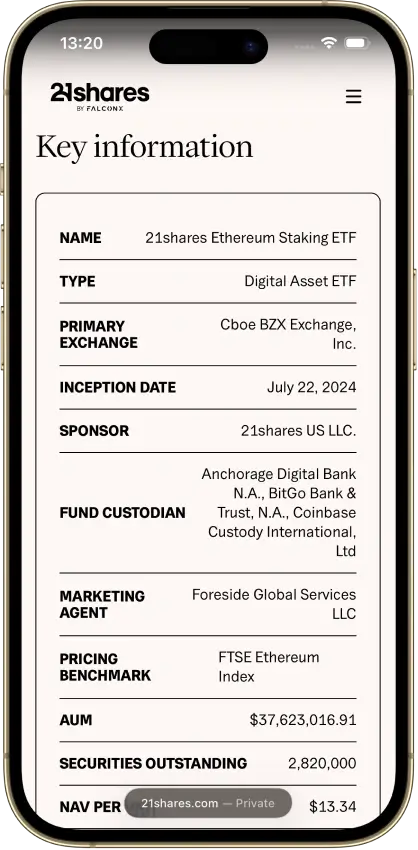
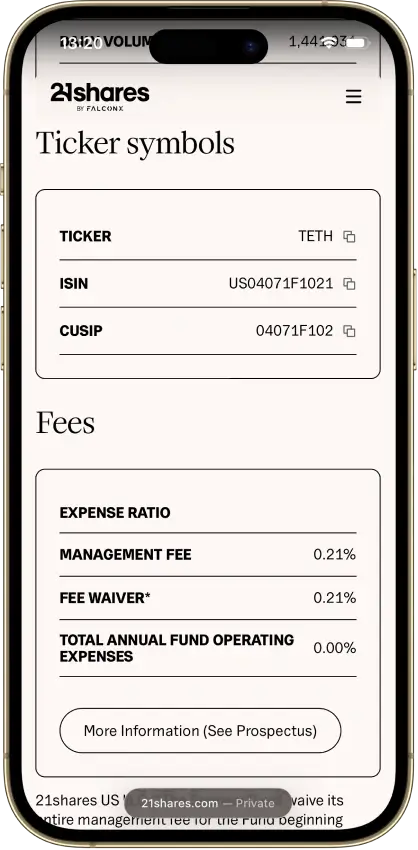
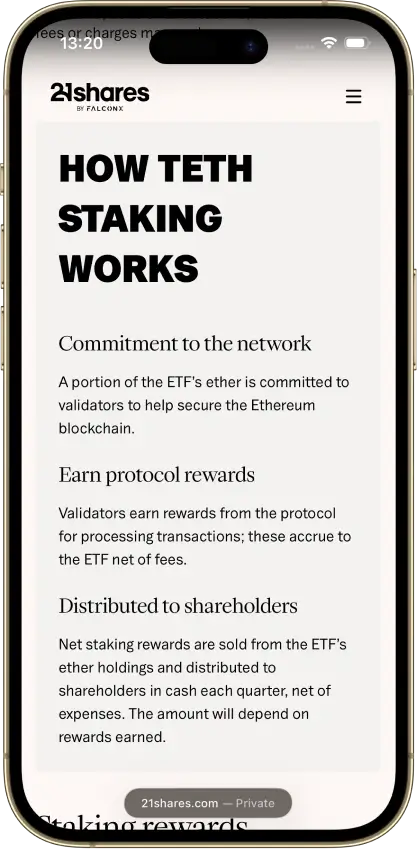
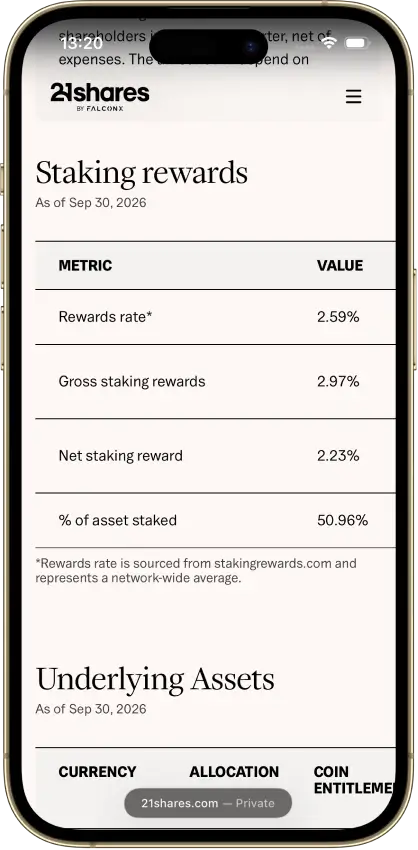
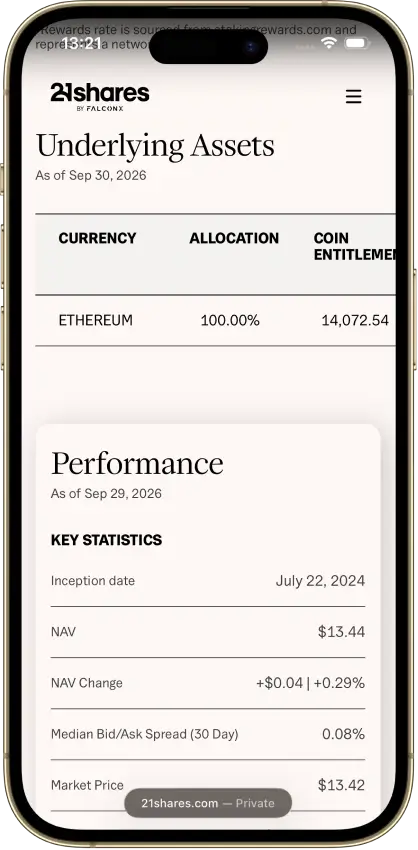

Screenshot 1 of 8
21Shares Ethereum Staking ETF Pros and Cons
Pros
- Named providers with public contracts
- Figment reimburses slashing, subject to caps
- Staked share published daily
Cons
- 25% of gross staking rewards withheld
- Small fund: $27.61M at October 9, 2026
- Higher threshold for custody-loss recovery
Who TETH Is For
TETH suits investors who want staking income from an ether fund and care about who runs the validators and on what terms.

What TETH Is and How It Works
TETH holds ether so that its shares follow ether’s price, less expenses, and it adds the staking rewards the trust receives. It holds the ether itself and uses no futures contracts.
The fund launched in July 2024 as the 21Shares Core Ethereum ETF under the ticker CETH. It was later renamed the 21Shares Ethereum ETF, and took its current name, with “Staking” added, in August 2026.
Shareholders own an interest in the trust. They can hold and trade that security, but they do not control the private keys to its ether.
Benchmark and How to Check Tracking
Since August 27, 2026, TETH has valued its ether using the FTSE Ethereum Index. Before that it used the CME CF Ether-Dollar Reference Rate – New York Variant. The benchmark sets the daily price used to calculate net asset value.
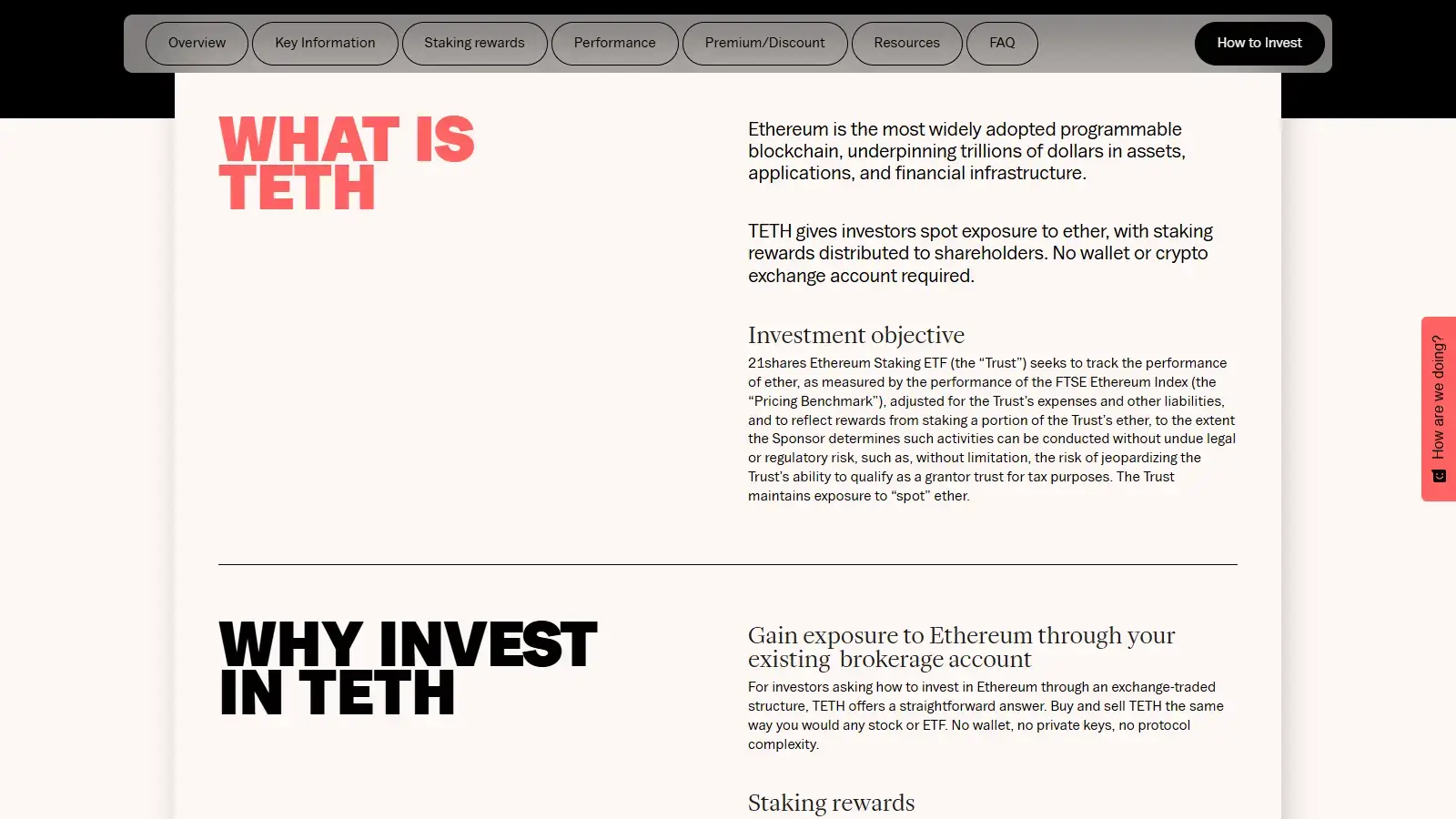
Net asset value, or NAV, is the value of the trust’s assets after liabilities, divided by the number of shares. Staking rewards are paid out in cash, so NAV alone understates what a shareholder earned. To judge tracking, compare the NAV return with the benchmark. To see what staking added, compare total return, including distributions, with the NAV return. The benchmark change in August 2026 affects any comparison that spans that date.
How TETH Stakes Its Ether
TETH stakes part of its ether through three named providers. Staking commits ether to validators that help run the Ethereum network, which pays rewards for that work.
Slashing Protection by Provider
TETH intends cash distributions from staking rewards at least quarterly. It paid $0.031603 per share on September 30, 2026. Rewards accrue to NAV before distribution; payment amounts vary and are not guaranteed.
The 2.60% “rewards rate” on the 21Shares page at October 9, 2026 is a network-wide average from Staking Rewards, not the fund’s own return.
Is TETH Safe? Custody and Investment Risks
A fall in ether’s market price can outweigh any staking income. The exchange listing offers no protection against that price risk.
Who Holds TETH’s Ether?
The fund’s appointed ether custodians are Coinbase Custody Trust Company, BitGo Bank & Trust, BitGo New York Trust Company and Anchorage Digital Bank.
Each custodian keeps the trust’s ether separate from its own assets. Each custodian’s contract also has at least one clause, for example on following instructions or on compromised access keys, where the custodian is liable only for gross negligence. Those conditions can limit recovery after a loss.
Staking providers do not hold the trust’s ether. They run validators for ether that stays with the custodians.
Fund Structure and Regulatory Status
TETH is a Delaware statutory trust and is not registered under the Investment Company Act of 1940. Calling it an ETF does not give it the protections of a fund registered under that act.
TETH Fees and Trading Costs
Besides the sponsor fee, TETH withholds part of its staking rewards, and trading the shares adds costs of its own.
The sponsor extended the fee waiver through October 8, 2027. Without that waiver, the ongoing 0.21% charge on a constant hypothetical $10,000 fee base for a full year would be $21, and at the 2.6178% reference staking rate the 25% cut on 61.62% staked ether adds about $40.33, for roughly $61.33 before the waiver and trading costs. During the waiver the sponsor-fee component is zero. Your costs move with the value of the holding and the network’s staking rate, and trading costs come on top.
Buying and Selling TETH
TETH trades on Cboe BZX. Brokerage access varies by account and location. Some brokers may still show the fund under an older name, so confirm the ticker before placing an order.
Share Price and NAV
The share price can sit above NAV, called a premium, or below it, called a discount. A small fund can trade with wider spreads, which raises the cost of getting in and out. When authorized participants create or redeem shares with the trust, the market price tends to move back toward NAV.
Ether Withdrawals and Retail Shares
Buying a share does not put ether into a wallet you control. Retail investors buy and sell shares on the market. Authorized participants create and redeem shares with the trust in blocks. That process gives an ordinary shareholder no way to withdraw ether personally.
Where to buy TETH
Explore broker options for 21Shares Ethereum Staking ETF.
TETH — Cboe BZX · United States


Robinhood
U.S. accounts, subject to account eligibility and trading permissions.
Eligibility details for Robinhood
- Account access
- U.S. self-directed securities brokerage through Robinhood Financial LLC; check IRA and fractional-share eligibility in your account
- Eligibility
- U.S. accounts, subject to account eligibility and trading permissions.
- Access notes
- Trade TETH shares through Robinhood’s U.S. securities brokerage.

Webull
U.S. accounts, subject to account eligibility and trading permissions.
Eligibility details for Webull
- Account access
- U.S. self-directed securities brokerage through Webull Financial LLC; check IRA and fractional-share eligibility in your account
- Eligibility
- U.S. accounts, subject to account eligibility and trading permissions.
- Access notes
- Trade TETH shares through Webull’s U.S. securities brokerage.
Availability depends on country and account.
TETH Alternatives
Staking ether yourself lets you choose the validator and hold the keys, with full responsibility for the wallet. A staking service runs the validator for you, under its own terms.
TETH vs ETH
Grayscale’s Ethereum Staking Mini ETF (ETH) is shown with fund data dated September 24, 2026. Its 0.15% sponsor fee and 6% reward cut are below TETH’s ongoing terms.
| Comparison | TETH | ETH |
|---|---|---|
| Annual sponsor fee | 0.21% (0% until Oct. 8, 2027) | 0.15% |
| Cut of gross staking rewards | 25% | 6% |
| Share staked | 61.62% (Oct. 9, 2026) | 77.00% (Sep. 24, 2026) |
| Public slashing recourse | Two of three providers reimburse | Validator reimbursement terms are unspecified. |
ETH keeps far more of its staking rewards and stakes a larger share. TETH is the one with public contracts that pay back slashing losses from two of its providers.

Ethereum ETF Pillar Scores
- Fund fees 24% weight Ongoing sponsor charge before temporary waivers, fee basis, covered expenses, extra fund costs, and waiver terms.8.3 / 10
- Trading spread 20% weight Median difference between bid and ask prices over 30 days.8.4 / 10
- Fund size 8% weight Value of the fund’s assets.2.0 / 10
- Staking & reward sharing 20% weight Share of fund ETH staked and the share of gross staking rewards retained for shareholders after all reward deductions.4.6 / 10
- Custody & asset rights 16% weight Fund ownership, asset records, custody-loss liability, withdrawal rights, and recourse for provider-caused slashing.6.0 / 10
- Reporting & transparency 12% weight Required reports, public ETH and staking holdings, benchmark, NAV, and management's disclosure-control conclusions.10.0 / 10
Final Verdict
TETH names three staking providers and publishes their agreements. Figment and Twinstake promise slashing reimbursement subject to caps and conditions. Coinbase’s filed agreement also promises reimbursement, but its covered-loss term is undefined. Investors should consider those differences alongside each custodian’s liability limits. The trust withholds 25% of gross staking rewards, and its temporary sponsor-fee waiver runs through October 8, 2027. It reported $27.61 million in net assets on October 9, 2026. TETH is relevant to investors who value named providers and public contracts. It does not provide ether withdrawals or control over validators.

Best For
Investors who want a staking ether fund whose staking providers are named and whose contracts are public.
Avoid If
- You want the lowest cut of staking rewards, a large fund, or need to withdraw ether.
CryptoSlate may earn a commission when you use partner links, at no extra cost to you. Our reviews, ratings, and editorial decisions remain independent of advertisers. Read How CryptoSlate Makes Money for funding details.